
Where Precision Meets Tradition
Japan – a nation that transformed baseball from a Western import into the very soul of its sporting culture. From its humble beginnings in the early 1870s to its current position as a global leader in sports technology, the evolution of Japanese baseball is a story of relentless pursuit of perfection – a spirit of “craftsmanship” infused into every pitch, every swing, and every innovation.
About Japan’s Baseball Innovation
Baseball was introduced to Japan between 1867 and 1873 by Professor Horace Wilson. In 1878, the first organized baseball team was established in the country. Over more than 150 years, Japan has not only cultivated a unique baseball culture but has also continuously pushed the sport forward through technological innovation.
Today, Japan is a major engine of baseball technology worldwide. From the world’s first catapult‑style pitching machine in 1958 to the biomechanical analysis technology now sought after by the Chicago Cubs of Major League Baseball, Japan’s influence in training, data analysis, and player development has achieved a “reverse export” – from learning from America to being sought after by America.
Three Core Innovations
Innovation 1: The Evolution of the Pitcher’s Mound and Pitching Mechanics
Period: 1870s – 1980s
Core Impact: Shaped the distinctive Japanese style of “precision control and varied pitch sequencing,” laying the foundation for world‑class pitchers.
When baseball was introduced to Japan in the early 1870s, pitchers used simple underhand throws. It was not until 1895, with the introduction of American rules, that overhand pitching began to appear.
Key Milestones – A series of rule adjustments drove the evolution of pitching mechanics:
1905 – Introduction of the pitcher’s mound (up to 15 inches high)
Effect: Pitchers gained a height advantage for downward throws; high‑position pitching gained prominence.
1941 – Rule allowed pitchers to take one step backward before pitching
Effect: Enabled pitchers to raise their front leg to generate greater power.
1956 – Strike zone narrowed
Effect: Focus shifted from power to precision control, prompting a change from “tilt” to “vertical” delivery.
1988 – Mound height reduced to 10 inches; strike zone further adjusted
Effect: Pitchers increasingly emphasised low pitches, with control stability reaching its peak requirement.
Far‑reaching Impact: The Japanese pursuit of ultimate control made its pitchers world‑renowned for pinpoint accuracy and varied pitch sequencing. This explains why Japan has consistently produced world‑class pitchers such as Hideo Nomo, Ichiro Suzuki, and Shohei Ohtani. This evolutionary path enabled Japanese pitchers – even without overwhelming velocity – to compete at the highest levels through superior command and tactical intelligence.
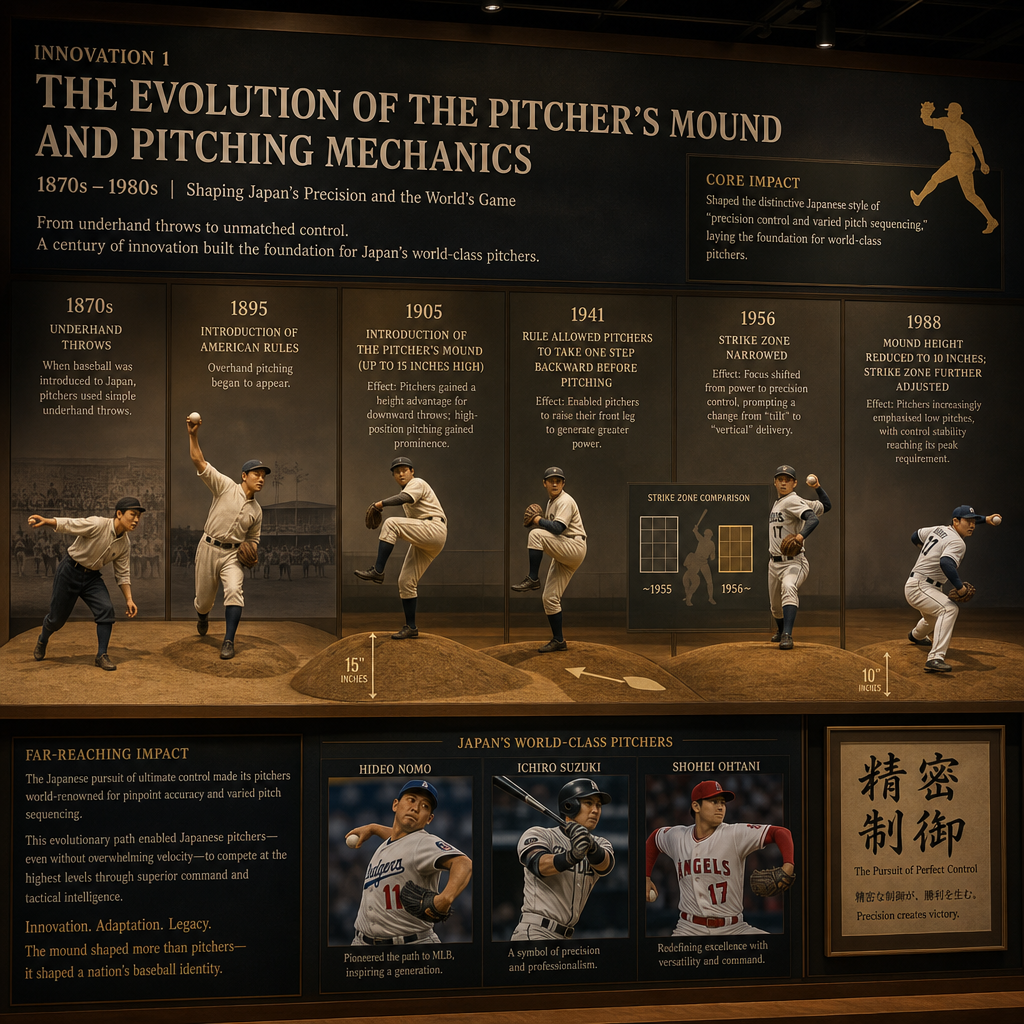
Figure 1. Pitcher’s Mound and Pitching Mechanics
Innovation 2: The Pitching Machine and the Spread of Batting Centres
Inventor: Hachio Saito (Lecturer at Kanto Gakuin University)
Models: KS‑P and AR types
Year: 1958
Technology: Compressed‑spring ejection, capable of throwing 12 fast or slow balls per minute
Recognition: Designated as “Mechanical Engineering Heritage No. 109” by the Japan Society of Mechanical Engineers
In 1958, a revolution in batting practice began in Japan. Hachio Saito, a lecturer at Kanto Gakuin University, invented Japan’s first catapult‑type pitching machine – the “KS‑P” and “AR” models. Using a compressed spring mechanism, the machine could consistently throw fastballs or breaking balls, marking a giant leap in training efficiency and precision.
Origin Story: Before the pitching machine, batting practice relied heavily on live pitchers, which was inefficient and inconsistent. Drawing on mechanical engineering knowledge, Saito designed a repeatable, controllable pitching device that fundamentally changed practice methods. The KS‑P model is now displayed at the Tokyo Baseball Hall of Fame Museum, while the AR model is exhibited at the Chunichi Batting Centre in Gifu, serving as precious testimonies to Japan’s sports technology history.
Far‑reaching Impact: The spread of pitching machines directly led to the establishment of batting centres across the nation.
- For players: Provided high‑intensity, repeatable practice opportunities, helping hitters refine their skills from professionals to amateurs.
- For the public: Brought the joy of baseball to ordinary people as a new form of entertainment, greatly broadening the sport’s grassroots base.
Continuing Leadership: Japan’s pitching machine technology remains world‑class. For example, the SoftBank Hawks have introduced the Trajekt Arc smart pitching machine at a high rental cost of 100 million yen for three years; and in Major League Baseball, seven teams including the Los Angeles Dodgers use Japanese‑made pitching machines. From the spring‑driven machines of 1958 to today’s AI‑powered smart machines, Japan has consistently stayed at the forefront of this field.
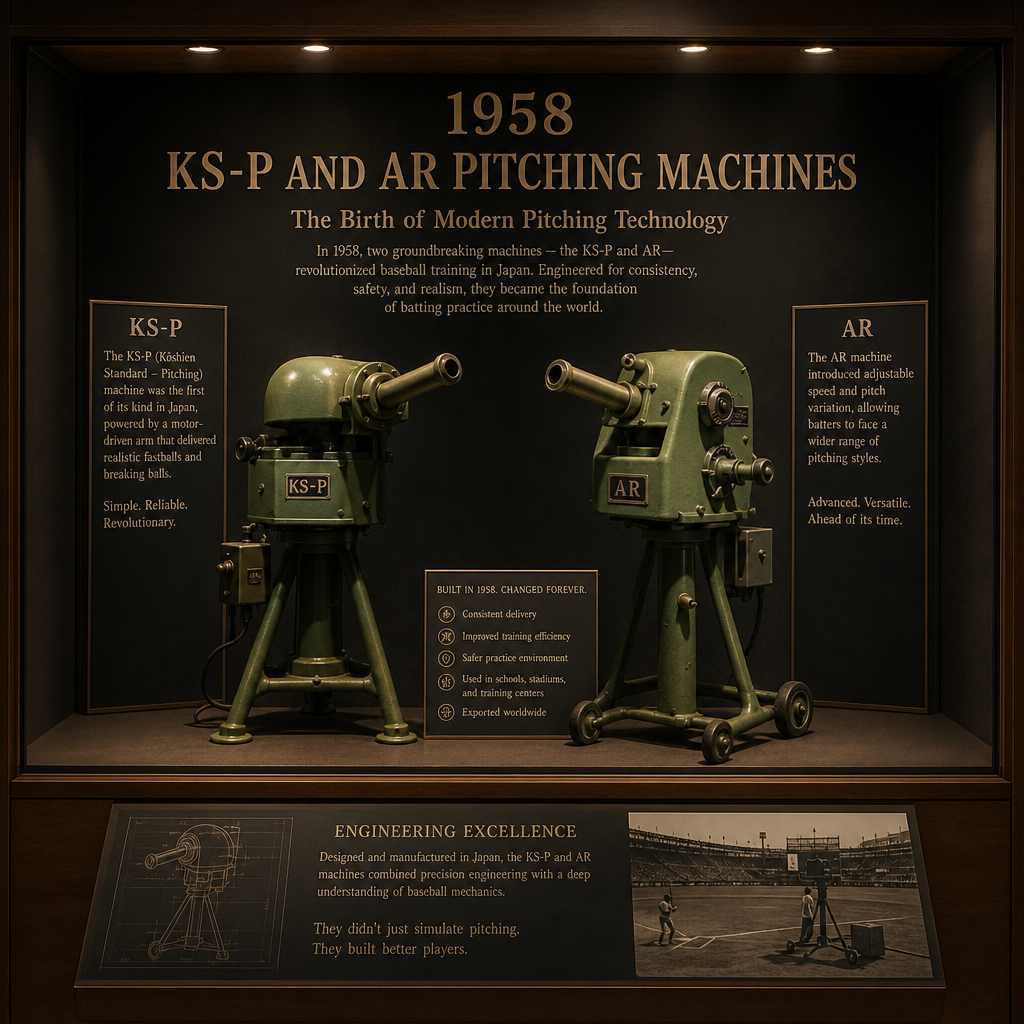
Figure 2. The Pitching Machine in 1958.
Innovation 3: Pioneers of Data Baseball
Pioneer Company: “ASOBO‑UZU” (founded by Katayama Munetomo in 1995)
Key Promoter: Bobby Valentine (managed the Chiba Lotte Marines from 2004 to 2009)
Major Achievement: 2005 Japan Series championship, using 125 different batting line‑ups in 136 games that season.
Before “Sabermetrics” swept the globe from America, Japan already had its own data‑revolution pioneers.
Key Figures and Events:
- ASOBO‑UZU Company: Founded by Katayama Munetomo in 1995. This company conducted data collection and research through video analysis and other means. Its influence was so significant that it once considered expanding into Major League Baseball. It opened the curtain on Japan’s data‑driven baseball revolution, at a time when data was not yet mainstream, already using video frame‑by‑frame to analyse pitcher mechanics and batter tendencies.
- Bobby Valentine: This American manager, during his tenure with the Chiba Lotte Marines from 2004 to 2009, brought in data analysts from the United States and applied large‑scale data analysis to actual games. In 2005, he led this budget‑limited team to win the Japan Series championship. Over the 136‑game season, he used 125 different batting orders – a revolutionary “scientific deployment” based on opponent data and player condition analysis. His success proved the value of data analysis and later influenced the American baseball world as well.
Far‑reaching Impact: Valentine’s success broke traditional beliefs and proved that scientific analysis can lead to victory. Today, data analysis is an indispensable part of Japanese professional baseball. Clubs not only have full‑time data analysts but also widely use high‑tech devices such as TrackMan and Rapsodo to quantify player performance. For example, the SoftBank Hawks have established a 16‑level multi‑stage player evaluation system integrated with cutting‑edge technology – from draft to first‑team promotion, every step is supported by data. The seeds of data baseball that were planted in Japan have now grown into a flourishing tree.
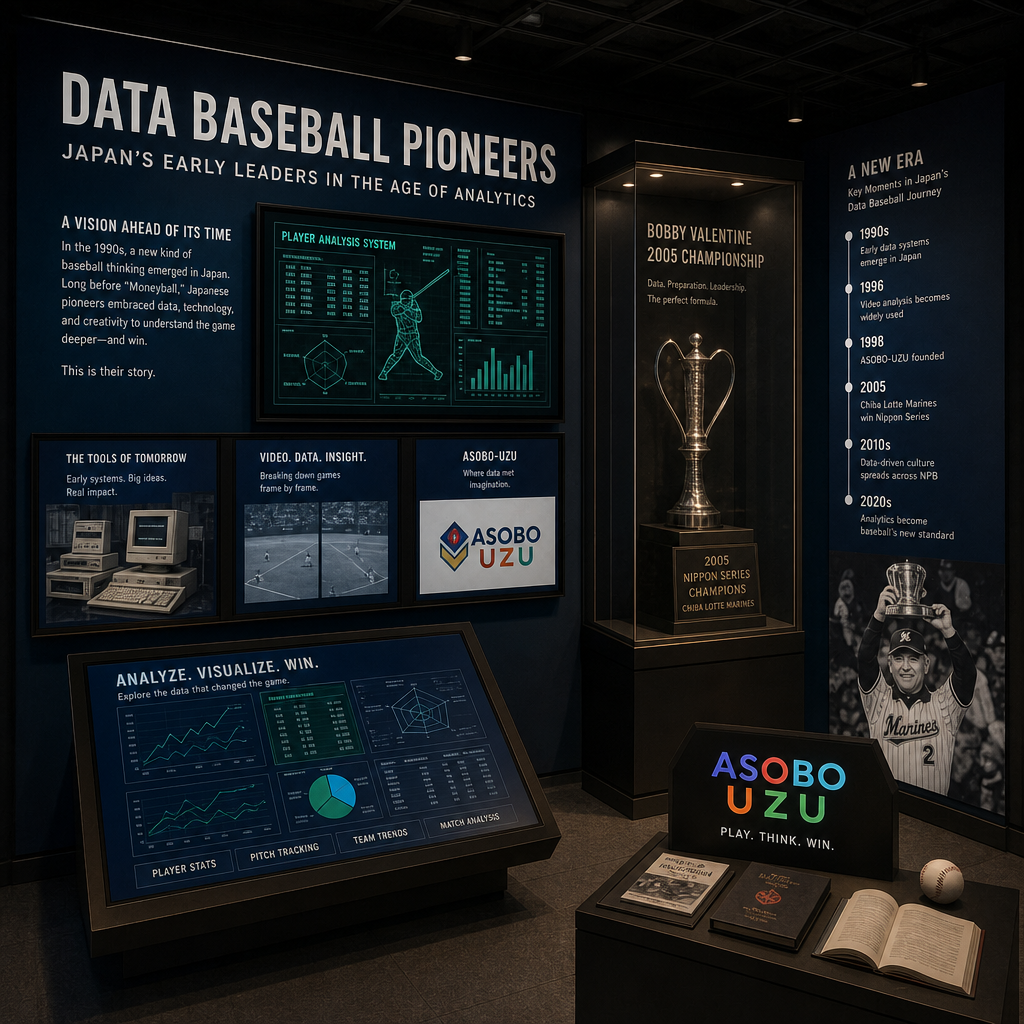
Figure 3. Data Baseball Pioneers
Japan’s Baseball Innovation Timeline
1867–1873 – Baseball introduced to Japan by Horace Wilson.
1878 – First organised baseball team established in Japan.
1905 – Pitcher’s mound introduced (up to 15 inches); high‑position pitching emerges.
1941 – Pitchers allowed to step back; high leg‑kick becomes standard.
1956 – Strike zone narrowed; shift toward precision control.
1958 – Hachio Saito invents Japan’s first catapult‑type pitching machine (KS‑P/AR).
1988 – Mound lowered to 10 inches; low‑pitch control becomes mainstream.
1995 – Katayama Munetomo founds ASOBO‑UZU, opening the data baseball era.
2004–2009 – Bobby Valentine manages the Marines; data science leads to championship.
2005 – Marines win Japan Series with 125 different batting orders.
Present – TrackMan, Rapsodo widely adopted; SoftBank establishes 16‑level evaluation system; Trajekt Arc smart machines introduced to NPB.
Why Japan Leads in Baseball Innovation
Advantage 1: Precision Manufacturing and Traditional Craftsmanship
From the spring‑driven machines of 1958 to today’s AI‑powered pitching devices, Japan’s legacy of precision engineering provides a solid hardware foundation for baseball equipment innovation, attracting MLB teams to purchase Japanese‑made training machines.
Advantage 2: The Ultimate Pursuit of “Control”
The century‑long evolution of mound rules has shaped the Japanese philosophy of “control over velocity” – this attention to fine technique extends to training equipment and data analysis as well.
Advantage 3: Integration of Data with Traditional Wisdom
Japan did not simply import American data analytics; instead, it combined them with its native spirit of meticulous observation. Video analysis was already being done before Sabermetrics became popular, forming a uniquely Japanese data‑baseball system.
References
- 広尾晃. (2024, October 27). イチローを丸裸にした恐るべき攻略法「卑怯だと言う人もいるかもしれないが…」. DIAMOND Online. https://diamond.jp/articles/-/352131
- Hawk-Eye Innovations. (2026, February 26). One data foundation, new fan experiences: Hawk-Eye and the future of Japanese baseball. https://www.hawkeyeinnovations.com/news/4457223/
- Japan Society of Mechanical Engineers. (2021). Japanese oldest pitching machines Catapult type: KS-P/AR (Mechanical Engineering Heritage No. 109). https://www.jsme.or.jp/kikaiisan/heritage_109_en.html
- Japan Society of Mechanical Engineers. (2021). 日本現存最古のピッチングマシン カタパルト式:型式KS-P型/型式AR型 (機械遺産 第109号). https://www.jsme.or.jp/kikaiisan/heritage_109_jp.html
- Next Base Inc. (2024, November 5). 〖日本企業初〗シカゴ・カブスとピッチング動作分析のサポート契約を締結!. https://nextbase.co.jp
- Nippon.com. (2025, March 17). Captivating capture tech: Japanese motion analysis makes inroads in Major League Baseball. https://www.nippon.com/en/japan-topics/g02483/
- Nippon.com. (2025, March 12). 「世界第一的動作分析」:日本運動科技的精髓獲得大聯盟認可. https://www.nippon.com/hk/japan-topics/g02483/
- Sony Corporation. (2025, March 27). 日本野球機構におけるデータ活用の拡充に向けたコンテンツ制作システムを開発 [Press release]. https://www.sony.co.jp
- The Japan Journal of Sport History. (n.d.). The historical developing process of overhand pitching in Japan from the 1870s to 2008. J‑STAGE. https://www.jstage.jst.go.jp/browse/jjshjb/28/0/_contents/-char/en
- Wikipedia. (n.d.). 2005 Japan Series. https://en.wikipedia.org/wiki/2005_Japan_Series
- Wikipedia. (n.d.). Pitcher’s mound. https://en.wikipedia.org/wiki/Pitcher%27s_mound
- Wikipedia. (n.d.). Pitching machine. https://en.wikipedia.org/wiki/Pitching_machine
- 日刊スポーツ. (2025, December 29). ソフトバンク 3連覇へ最新兵器”補強”へ「トラジェクトアーク」本拠地に2台目導入. 日刊スポーツ. https://www.nikkansports.com
- スポニチ. (2025, December 2). ソフトバンクが来季3台目を“追加補強”へ 最先端打撃マシンをフル活用でV3目指す. スポニチ Sponichi Annex. https://www.sponichi.co.jp