Introduction
Baseball sound technology has evolved dramatically over more than eight decades. From the first electronic organ installed in a Major League ballpark to AI-powered spatial audio systems that move individual sounds through physical space, each innovation has transformed how fans experience the game. Unlike the baseball bat—which evolved through materials and manufacturing—sound technology evolved through electronics, broadcast engineering, and digital software. Studying this evolution provides insight into how audio innovation shapes fan engagement, player performance, and the very atmosphere of baseball itself.
Early Stadium Audio: The Ballpark Organ (1941)
The first electronic organ installed at a Major League Baseball ballpark marked the beginning of designed stadium soundscapes. Before 1941, ballpark audio consisted entirely of natural crowd noise and occasional public address announcements.
The Wrigley Field electronic organ , installed in 1941, was a Hammond Model BC console organ featuring two manuals (keyboards), bass pedals, and a wooden cabinet. Installed in the Cubs’ press box, it projected sound through the stadium’s public address system , reaching all seating areas. Leslie A. “Les” Sprague became the first ballpark organist , improvising between innings and providing musical punctuation for key moments.
This innovation established the tradition of organ-led fan chants , player introduction music, and between-inning entertainment that spread to nearly every MLB ballpark by the 1960s. As musicologist Matthew W. Mihalka documented, the organ survived not because it was traditional, but because organists were willing to adopt modern musical trends .
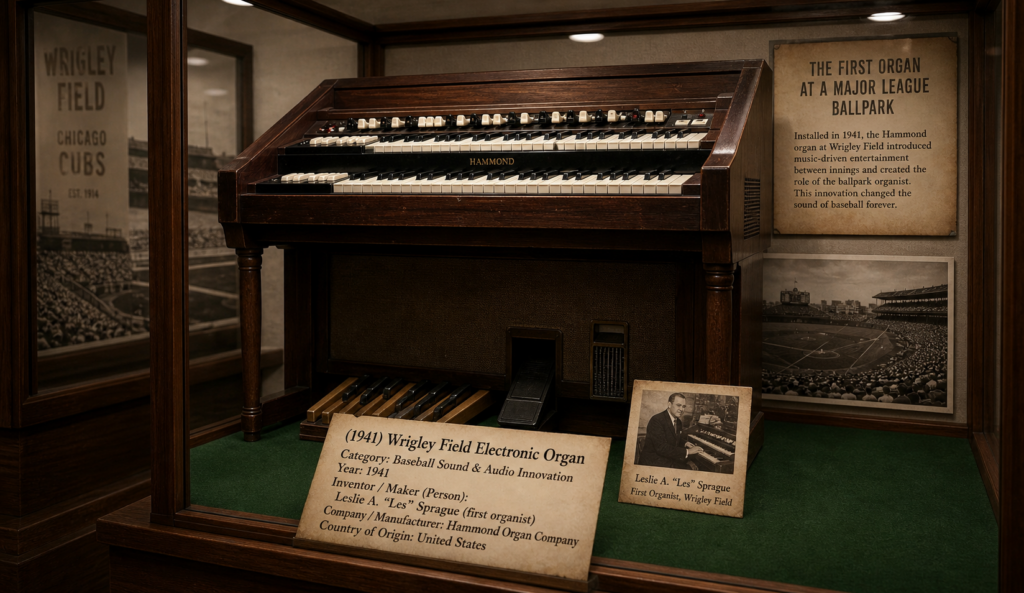
Key figure: Leslie A. “Les” Sprague (first organist), Hammond Organ Company (manufacturer)
Reference: Mihalka, M. W. (2012). From the Hammond Organ to “Sweet Caroline”: The Historical Evolution of Baseball’s Sonic Environment (Doctoral dissertation). University of Minnesota.
Broadcast Audio Innovation: The “Crack of the Bat” Parabolic Microphone (1950s)
The parabolic microphone system , developed by CBS broadcast engineers in the 1950s, solved a problem that had frustrated radio and television producers for decades: how to make home audiences feel inside the stadium.
Before this innovation, broadcast audio was primarily ambient crowd noise with distant, muffled on-field sounds. The parabolic microphone—a large reflector dish (18-24 inches diameter) with a small condenser microphone at its focal point—could isolate and amplify specific sounds such as the crack of the bat, the pop of the catcher’s mitt, and the umpire’s call.
The nickname “Crack of the Bat” became shorthand for immersive audio. As broadcast historian James R. Walker noted, this technology transformed baseball listening from passive observation to dramatic audio experience .
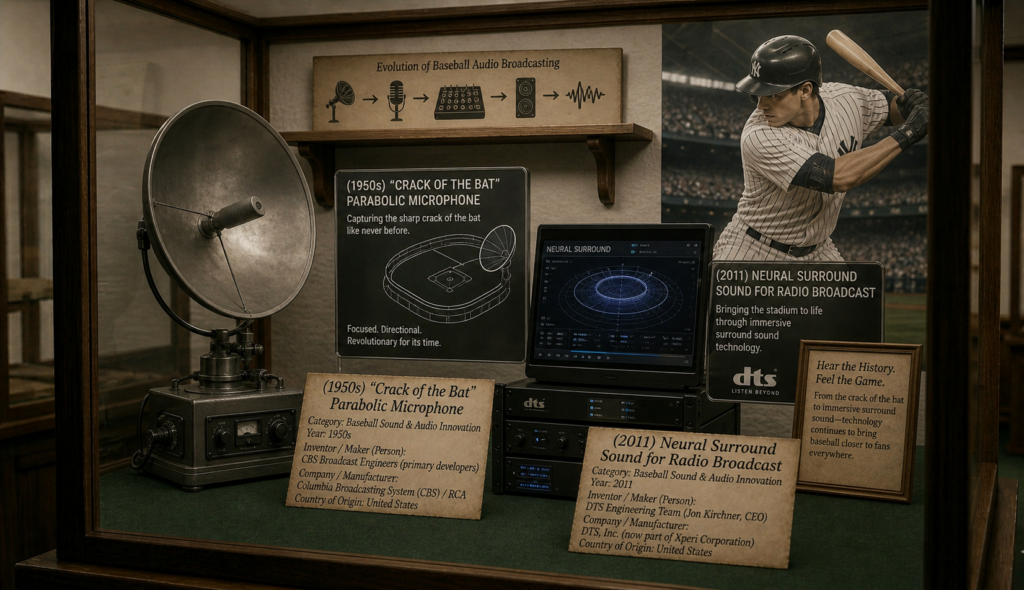
Key figure: CBS Broadcast Engineers, RCA (manufacturer)
Reference: Walker, J. R. (2015). Crack of the Bat: A History of Baseball on the Radio. University of Nebraska Press.
Player Audio Identity: Walk-Up Song Cueing System (1970s–1990s)
The walk-up song cueing system was not a single invention but an evolution of ballpark audio technology that formalized playing a short, personalized song for each batter as they approach home plate. Emerging from the 1970s through the 1990s, this innovation converted player introductions from simple name announcements into theatrical, musical moments.
Before walk-up songs became standard, batters were introduced only by the public address announcer or, occasionally, by a brief organ flourish. The new system added a layer: each player selected his own music, and stadium audio operators cued the song as the batter left the on-deck circle.
This practice gave players a new form of self-expression and fans a way to identify with individual athletes before a single pitch was thrown. The walk-up song also became a form of psychological preparation for players, helping them focus and block out crowd noise.
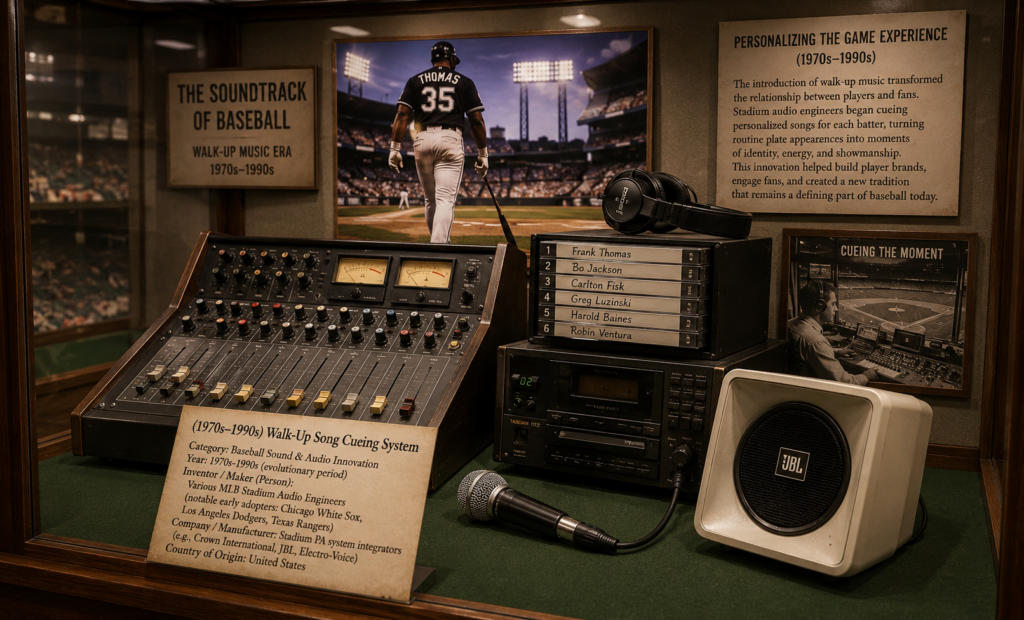
Key figure: Various MLB stadium audio engineers (early adopters: Chicago White Sox, Los Angeles Dodgers)
Reference: MLB Advanced Media. (2018). Official Walk-Up Song Database. Major League Baseball.
On-Field Audio Capture: Microphone-Equipped Baseball Base (2005)
The microphone-equipped baseball base , patented by inventor James Cracolici in 2004 and granted in 2006, represented a direct response to a problem broadcasters had faced for decades: television and radio audiences could not hear the intimate sounds of the game happening on the field—players sliding into bases, the impact of cleats on the bag, and quiet communications between runners and coaches.
The invention embedded a small microphone and wireless transmitter directly into a regulation baseball base. The patent addressed a key technical challenge: protecting the microphone from damage when players stepped on the base. The solution placed the microphone in a channel along the outside surface of the base, filled with a non-noisemaking substance (silicone) to cushion it without creating unwanted noise.
The system was designed for installation on first, second, and third base , with each base transmitting on a different radio frequency, allowing broadcasters to select which audio signals to mix into their telecasts.
Key figure: James Cracolici (inventor)

Reference: Cracolici, J. (2006). Baseball device with sound. United States Patent Application US20060089214A1.
Immersive Radio Broadcast: Neural Surround Sound (2011)
The Neural Surround Sound system for radio broadcast , implemented by the Atlanta Braves Radio Network in 2011, represented a fundamental breakthrough in how baseball sounded on the radio. For the first time, listeners could experience baseball games in 5.1 channel surround sound over standard stereo FM radio signals.
The technology used a coding system that encoded surround sound information within a standard two-channel stereo signal. Any FM radio could decode the enhanced stereo signal, but radios equipped with surround sound decoders could reproduce the full 5.1 channel experience , placing the listener “in the grandstands” with the crowd around them.
The Braves Radio Network, the largest in baseball with 150 affiliates across the southeastern United States, became the first major sports network to deliver surround sound baseball broadcasts over terrestrial radio. Gary Kline, Vice President of Engineering for Cumulus Media, noted that the surround sound was particularly effective in digital HD Radio , where “the sound is amazing.”
Key figure: DTS Engineering Team (Jon Kirchner, CEO)
Reference: Radio World Staff. (2011, September 6). “Braves Radio Network Implements Surround Sound.” Radio World.
Player Communication Innovation: PitchCom Wireless Pitch-Calling System (2022)
The PitchCom wireless pitch-calling system , introduced at MLB Opening Day 2022, allows catchers to transmit pitch calls directly to pitchers through a small speaker hidden inside the pitcher’s hat. Instead of using traditional finger signs—which could be observed by base runners or coaches—the catcher presses buttons on a wrist-worn keypad , selecting pitch type and location. The pitcher hears a pre-recorded voice announcing the call, such as “fastball high” or “curveball away.”
PitchCom solved two problems that had frustrated baseball for over a century. First, it eliminated sign stealing —electronic or visual theft of catcher’s signs that had damaged the sport’s integrity. Second, when MLB introduced a pitch timer in 2023, catchers could no longer waste time cycling through multiple signs. PitchCom delivered the call instantly.
The system also changed what baseball sounded like. For the first time in 150 years, fans could not hear catchers giving signs—because there were no verbal or audible signs to hear. The communication happened silently, electronically , inside the pitcher’s ear.
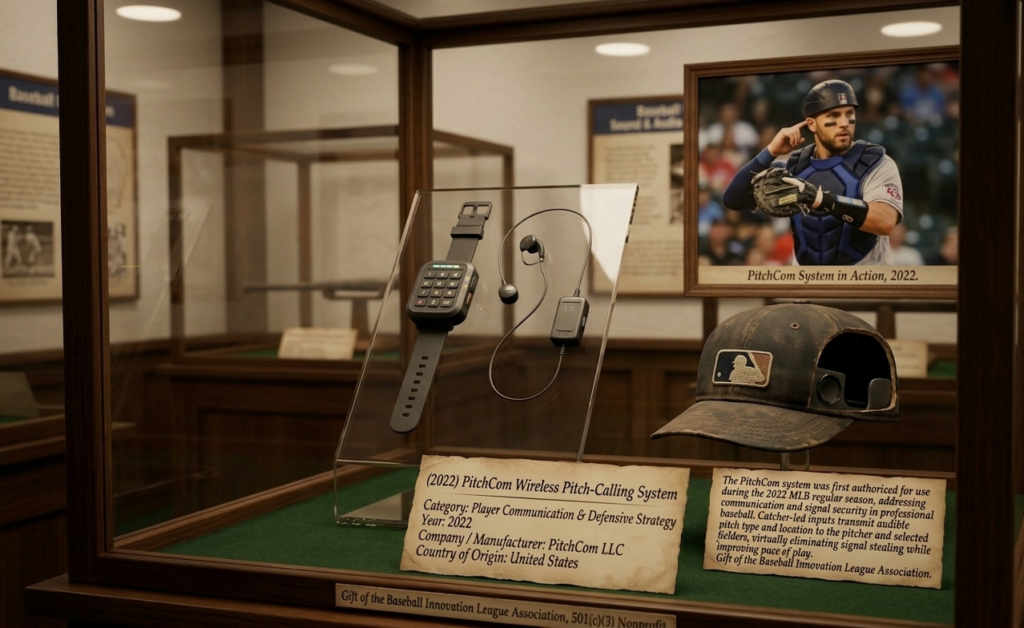
Key figure: John Hankins, Craig Filicetti (co-founders)
Reference: Passan, J. (2022, April 7). “How PitchCom became baseball’s newest — and loudest — innovation.” ESPN.
Spatial Audio for Live Performance: L-Acoustics DJ System (2025)
The L-Acoustics DJ spatial audio system , announced in May 2025 and commercially launched in October 2025, is the first complete solution that transforms traditional stereo DJ setups into fully immersive spatial audio experiences in real time. Using machine-learning source separation , the system isolates individual sound elements—beats, basslines, melodies, and vocals—and allows the DJ to position and move them through physical space .
Unlike conventional sound systems that simply play music louder, this technology creates a three-dimensional audio environment where a vocal might sweep from left to right while the bass remains anchored in front and a synth melody rotates overhead. The system delivers sub-10-millisecond latency , ensuring spatial movement stays synchronized with the music’s rhythm.
While currently deployed in music clubs and festivals (making its U.S. festival debut at Miami’s III Points Festival in October 2025), this technology suggests future directions for ballpark sound : moving the sound of a home run from home plate through the air, creating positional audio cues for fans, or producing immersive between-inning entertainment that surrounds fans in 3D audio space.
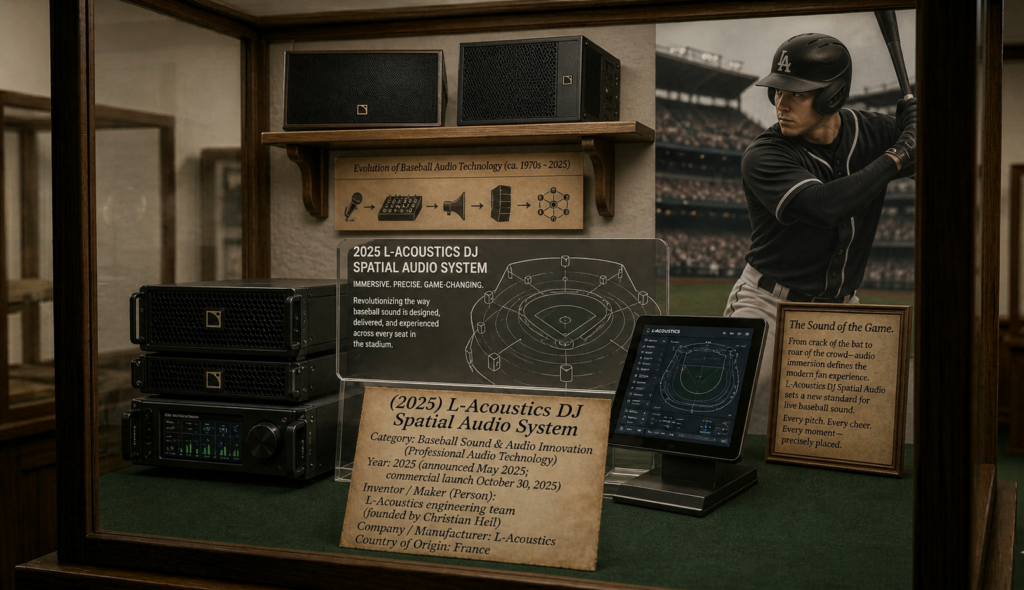
Key figure: L-Acoustics engineering team (founded by Christian Heil), France
Reference: L-Acoustics Official Website. (2025). L-Acoustics DJ Product Page. lacoustics.com.
Timeline of Baseball Sound Technology Innovation
The design of baseball sound technology has evolved significantly over more than eight decades. Advances in electronics, broadcast engineering, digital software, and spatial audio have contributed to continuous innovation.
| Year | Innovation | Description |
|---|---|---|
| 1941 | Wrigley Field Electronic Organ | First electronic organ installed at an MLB ballpark; created the role of ballpark organist. |
| 1950s | “Crack of the Bat” Parabolic Microphone | Directional microphone isolated bat-ball impact for dramatic broadcast audio. |
| 1970s–1990s | Walk-Up Song Cueing System | Personalized music for each batter became standard; player audio branding emerged. |
| 2005 | Microphone-Equipped Baseball Base | Hidden microphone inside base captures on-field player sounds for broadcast. |
| 2011 | Neural Surround Sound for Radio | Transforms stereo radio into surround sound for baseball broadcasts. |
| 2022 | PitchCom Wireless Pitch-Calling System | Catcher transmits pitch calls silently to pitcher’s hidden earpiece. |
| 2025 | L-Acoustics DJ Spatial Audio System | Moves individual sounds through physical space during live performances. |
References
Mihalka, M. W. (2012). From the Hammond Organ to “Sweet Caroline”: The Historical Evolution of Baseball’s Sonic Environment (Doctoral dissertation). University of Minnesota.
Walker, J. R. (2015). Crack of the Bat: A History of Baseball on the Radio. University of Nebraska Press.
Cracolici, J. (2006). Baseball device with sound. United States Patent Application US20060089214A1.
Radio World Staff. (2011, September 6). “Braves Radio Network Implements Surround Sound.” Radio World.
Passan, J. (2022, April 7). “How PitchCom became baseball’s newest — and loudest — innovation.” ESPN.
L-Acoustics Official Website. (2025). L-Acoustics DJ Product Page. lacoustics.com.
MLB Advanced Media. (2018). Official Walk-Up Song Database. Major League Baseball.