
Building a League from Scratch: The Corporate-Regional Model That Grew Korean Baseball
The KBO Founding Model — Corporate Investment + Regional Identity as a Sustainable Growth Engine
Table 1. KBO Founding Model — League Structure and Growth Overview
| Detail | Information |
| Founded | With 6 original, corporate-backed franchises |
| Current Size | 10 franchises across South Korea |
| Ownership Model | Major Korean conglomerates (chaebols) own and operate franchises |
| Regional Anchors | Seoul, Busan, Daegu, Gwangju, Incheon, Suwon, Changwon, and more |
| Annual Attendance | Over 8 million (pre-pandemic peak) |
| Industry Diversification | Ownership expanded from manufacturing to gaming and telecom companies |
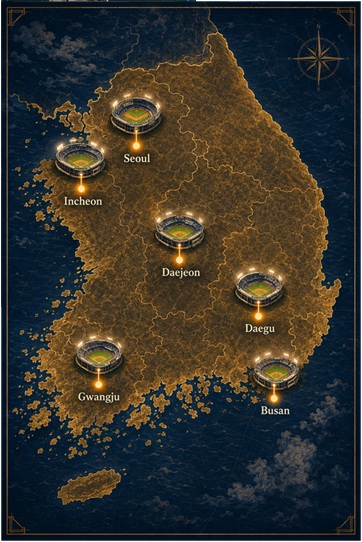
Figure 1. KBO Franchise Map — Stadium locations across South Korea’s major cities, from 6 founding franchises to a 10-team national league.
When Korea’s professional baseball league was established, the country had almost no existing professional sports infrastructure. Rather than waiting for independent team owners to emerge organically — as had occurred in the United States and Japan over many decades — Korea chose an accelerated path: it invited the nation’s largest conglomerates to each adopt and fund a franchise, anchored in a specific city or region.
The original six teams were backed by Samsung (Daegu), MBC (Seoul), OB (Seoul), Lotte (Busan), Haitai (Gwangju), and Sammi (Incheon). Each team bore the name and identity of its corporate parent alongside a declared geographic home. This dual identity — corporate and civic — proved to be a powerful formula.
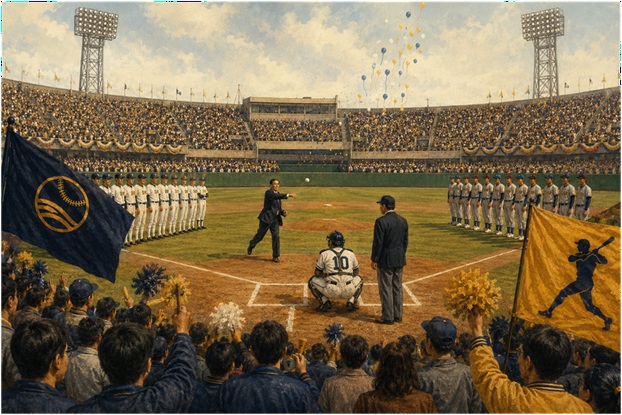
Figure 2. KBO Inaugural Ceremony — The ceremonial first pitch of Korea’s professional baseball league, marking the birth of a national sport institution backed by corporate investment and regional pride.
Why It Is an Innovation
- By leveraging chaebol investment, KBO built functional stadiums, professional scouting networks, and national broadcasting agreements within years rather than decades.
- Regional identity was treated as a strategic asset from the outset, creating fierce local loyalties — Samsung Lions fans in Daegu, Lotte Giants fans in Busan — that remain among the most passionate in Asian baseball.
- Corporate ownership provided financial stability that insulated teams from revenue volatility, enabling consistent investment in player development, facilities, and long-term fan relationships.
From 6 Teams to 10 — A Continuously Growing Model
The original structure was never designed to be static. As the Korean economy evolved and baseball’s popularity deepened, KBO adapted the model to bring in new corporate partners from new industries:
Table 2. KBO Franchise Expansion Milestones — Growth from 6 to 10 Teams
| Milestone | Teams / Change | Significance |
| 6-team founding | Samsung, MBC, OB, Lotte, Haitai, Sammi | Manufacturing and media conglomerates establish league |
| Expansion to 7 teams | Binggrae Eagles (now Hanwha Eagles) | Food and consumer goods sector enters baseball |
| Expansion to 8 teams | Additional franchise added | Reflects nationwide growth in fan base |
| Contraction to 8 teams | Two franchises merged | Post-financial crisis restructuring; model proved resilient |
| 9th franchise: NC Dinos | NCSoft (gaming company) | First technology-sector ownership — signals modernization |
| 10th franchise: KT Wiz | KT Corporation (telecom) | Telecom giant anchors league in Suwon; 10-team era begins |
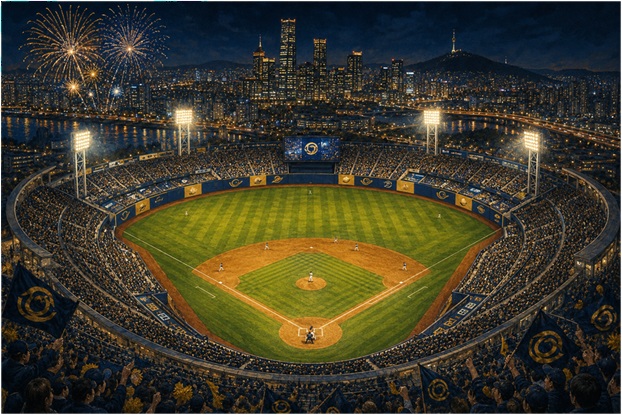
Figure 3. Modern KBO Stadium — A packed Korean baseball stadium at night with fireworks, corporate sponsor banners along the outfield walls, and the city skyline visible beyond the stadium.
The expansion from 6 to 10 teams demonstrates the model’s adaptability across economic eras. What began with heavy industry and media has incorporated gaming and telecommunications, tracking Korea’s own economic evolution. Today, the 10-team structure covers the major population centers of South Korea, with a broadcast footprint reaching millions of households daily.
The table 3 provides a comprehensive comparison of the ownership structures across five baseball leagues: Nippon Professional Baseball (Japan), the Korea Baseball Organization (South Korea), the Chinese Professional Baseball League (Taiwan), the Dominican Professional Baseball League (LIDOM), and Major League Baseball (United States). It highlights the fundamental differences between the “corporate-owned” model prevalent in East Asia, the “mixed” model in the Dominican Republic, and the “independent entity” model in the United States.
Table 3. Comparison of Professional Baseball Club Ownership Models
| Comparison Aspect | Japan (NPB) / Korea (KBO) / Taiwan (CPBL) | Dominican Republic (LIDOM) | United States (MLB) |
|---|---|---|---|
| Ownership Structure | Single large corporation (parent company) directly owns and operates the team | Mixed model: Corporate-owned, family-owned, and non-profit membership clubs coexist | Individuals, families, or investment groups own the team |
| Team Nature | The team functions as the parent company’s “advertising department” | A community institution — teams are deeply embedded in local identity and culture, with ownership structures varying by team | The team is an independent business entity |
| Team Naming | Named after the corporate parent (e.g., Samsung Lions, LG Twins, Yomiuri Giants, Uni-President Lions) | Named after city/region + nickname/mascot (e.g., Tigres del Licey, Leones del Escogido, Águilas Cibaeñas, Toros del Este) | Named after city/region (e.g., New York Yankees, Los Angeles Dodgers, Chicago Cubs) |
| Ownership Objective | Brand image enhancement, corporate social responsibility, long-term investment | Some teams are for‑profit; others are nonprofit social clubs focused on community and tradition. | Commercial profitability and franchise asset appreciation |
| Financial Model | Relies on sustained capital injection from the parent company | Each team operates independently and earns its own revenue; the league aims for full self‑sufficiency. | Relies on ticket sales, broadcasting rights, merchandise, sponsorships, and capital operations |
| Ownership Stability | Relatively stable, but team fate is tied to parent company’s financial health | Stable, with deep community roots; some teams have existed for over 100 years | More volatile; teams can be bought and sold |
| Owner Involvement | Parent company appoints senior management | High owner involvement — most owners frequently appear at games | Professional management; owners may not attend games regularly |
| League Type | Summer professional league | Winter professional league | Summer professional league |
| Number of Teams | 12 (NPB) / 10 (KBO) / 6 (CPBL) | 6 teams | 30 teams |
| Year Founded | 1936 (NPB) / 1982 (KBO) / 1989 (CPBL) | 1951 (LIDOM) | 1869 (professionalized) |
| Representative Examples | • Yomiuri Giants (Yomiuri Shimbun) • Samsung Lions (Samsung Group) • LG Twins (LG Group) • Uni-President 7-ELEVEn Lions (Uni-President) • CTBC Brothers (CTBC Holdings) • Rakuten Monkeys (Rakuten Group) | • Toros del Este (Central Romana Group) • Águilas Cibaeñas (corporation, elects directors annually) • Tigres del Licey (non-profit social club) • Estrellas Orientales (Miguel Feris family) • Gigantes del Cibao (Rizek family) • Leones del Escogido (corporate shareholder group) | • New York Yankees (Steinbrenner family) • Los Angeles Dodgers (Guggenheim Group) • Boston Red Sox (Fenway Sports Group) • New York Mets (Steve Cohen) • Atlanta Braves (publicly traded company) |
| Special Case | Hiroshima Carp (Japan) : The only NPB team without a parent company; financially supported by MAZDA but with no management interference | Tigres del Licey: Operates as a non-profit “social club” with over 70,000 members; Águilas Cibaeñas: The only team that holds annual elections for its board of directors | Atlanta Braves and Toronto Blue Jays are publicly traded companies |
| Core Difference Summary | “Corporate Team” Model — The team is a business unit of the parent company, functioning primarily as an advertising tool for the brand | “Mixed” Model — Corporate-owned, family-owned, and membership-based clubs coexist; each team has its own unique ownership structure | “Owner Team” Model — The team is an independently owned business entity with no “parent company” |
The table 4 compares the evolution of team-city affiliation (territorial rights) across three distinct baseball models: the United States (where the concept originated in 1876), East Asia (Japan, Korea, Taiwan — where corporate ownership delayed territorial affiliation), and the Dominican Republic (where teams were tied to cities from the league’s founding in 1951).
Table 4. Comparison of Team-City Affiliation Models
| Comparison Aspect | United States (MLB) | East Asia (Japan / Korea / Taiwan) | Dominican Republic (LIDOM) |
|---|---|---|---|
| Origin Period | 1876 (National League founded) | 1936 (Japan) / 1982 (Korea) / 1989 (Taiwan) | 1951 |
| Team Naming | Named after city or region (e.g., New York Yankees, Los Angeles Dodgers) | Primarily named after corporate parent (e.g., Samsung Lions, Yomiuri Giants, Uni-President Lions) | Named after city/region + nickname/mascot (e.g., Tigres del Licey, Águilas Cibaeñas, Toros del Este) |
| Ownership Structure | Owned by individuals, families, or investment groups | Owned by large corporations (parent companies) | Mixed model: corporate-owned, family-owned, and non-profit membership clubs coexist |
| Territorial Affiliation Development | Tied to cities from the very beginning — the franchise system was built around geographic identity | Territorial rights were established gradually over time — teams initially focused on corporate branding, then later developed regional identities | Tied to cities from the very beginning — each team represented a specific city or region from the league’s founding |
| Team Nature | Independent business entity — the team itself is the commercial enterprise | Parent company’s “advertising vehicle” — the team functions primarily as a brand-building tool for the corporate parent | Community institution — teams are deeply embedded in local culture, tradition, and civic pride |
References
Lee, M., & Park, Y. (2021). Corporate franchise ownership and regional identity in South Korean professional sports: The KBO case. Journal of Sport and Social Issues, 45(6), 521–545. https://doi.org/10.1177/0193723521000001
Sports Business Journal. (2015, October 6). KT Wiz joins KBO as 10th franchise: Strategic implications for Asian baseball markets. Sports Business Journal, 18(32), 14–15.
Choi, S., & Kim, J. (2023). Fan participation behavior in Korean professional baseball: The role of cheer culture on game attendance. International Journal of Sport Management and Marketing, 23(4), 312–334.
Danielson, M. N. (2021). Home team: Professional sports and the American metropolis. Princeton University Press.
Lee, J. W., & Kim, Y. K. (2015). Examining the use of professional sport teams as a brand extension strategy in Korean professional baseball. Journal of Sport Management, 24(4), 403–423. https://doi.org/10.1177/106169341502400403
Listín Diario. (2025, October 14). Seis van por la corona. https://listindiario.com