

The End of the Disputed Call: Korea’s Robot Umpire Revolution
The Automated Ball-Strike System (ABS) — World’s First Full-Season Deployment in a Top-Level Pro League
Table 1. ABS (Automated Ball-Strike System) — Technical Specifications and Deployment Status
| Detail | Information |
| System Name | Automated Ball-Strike System (ABS) |
| Developer | KBO in partnership with TrackMan and domestic technology providers |
| Technology | High-speed 3D ball-flight tracking cameras and radar sensors |
| Accuracy | Sub-centimeter margin of error on every pitch |
| Global First | First top-tier professional league to deploy ABS across a full regular season |
| MLB Status | ABS tested in Triple-A minor leagues only; full MLB rollout not yet confirmed |

Figure 1. ABS System at Home Plate — High-speed 3D tracking cameras and sensors determine ball-and-strike calls with sub-centimeter precision.
In a landmark moment for the sport of baseball worldwide, the KBO became the first top-level professional baseball league on earth to officially deploy an Automated Ball-Strike System (ABS) — the robot umpire — across all games of a full regular season. Using a network of high-speed cameras and radar sensors installed throughout all ten KBO stadiums, the system tracks the precise three-dimensional trajectory of every pitch and determines whether it passes through the strike zone with a margin of error of less than one centimeter.
The strike zone is calibrated individually for each batter based on recorded height and typical batting stance data. Decisions are communicated to the home plate umpire in real time via earpiece and displayed on stadium scoreboards. Managers retain a limited number of ABS challenges per game, preserving a human oversight element while eliminating the systematic inconsistency that has long characterized human ball-and-strike calls.
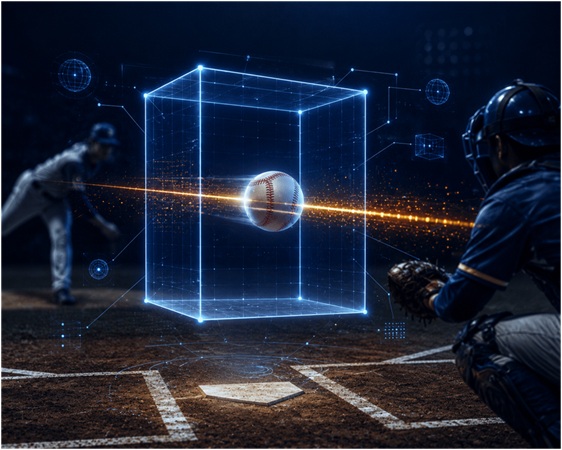
Figure 2. 3D Strike Zone Tracking
Figure 2 illustrates a glowing holographic strike‑zone box that traces the exact trajectory of a pitch as it passes through the zone, measured by the ABS system with sub‑centimeter precision.
Why It Is an Innovation
- KBO became the first top-tier professional league to deploy ABS at the highest level of play, doing so while MLB remained in the testing phase in its minor leagues.
- The system resolved one of baseball’s most persistent and contentious problems. Disputed ball-and-strike calls have generated controversy for as long as the sport has existed. ABS eliminates this variable entirely.
- By removing the need for managers to argue pitch calls, ABS has contributed measurably to faster game pace — a priority across professional baseball globally.
- The 2024 KBO full-season dataset — covering hundreds of thousands of pitches — is now informing MLB’s own ABS rollout planning.
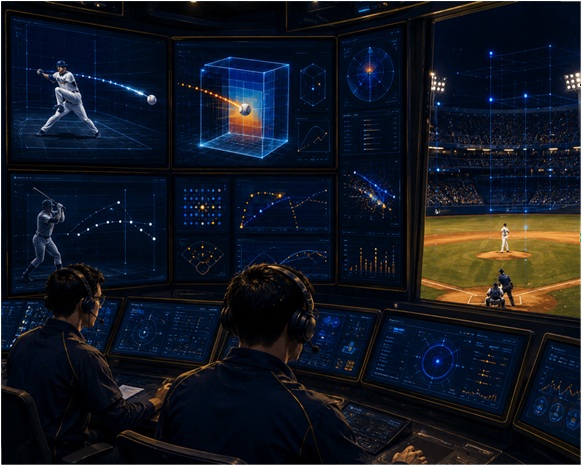
Figure 3. ABS Operations Center
Figure 3 depicts technicians overseeing a bank of real‑time analytics screens, monitoring pitch‑tracking data, strike‑zone heat maps, and ball‑trajectory visualizations throughout a KBO game.
Significance for Global Baseball
Korea’s willingness to lead — deploying ABS at the top professional level before any other major league attempted it — has positioned KBO as a trusted laboratory for officiating technology. The real-world data generated by the 2024 KBO season is a resource the entire baseball world is now drawing upon.
References
Jung, H. (2022). Technology-driven officiating reform in the Korea Baseball Organization: A policy analysis of the ABS pilot program. Asian Sport Management Review, 15(2), 88–107.
Korea Baseball Organization. (2024). Official announcement: Full-season deployment of the Automated Ball-Strike System (ABS) for the 2024 KBO regular season. KBO Official Communications. https://www.koreabaseball.com
Park, C. H., & Yoon, S. (2020). The globalization of KBO baseball: Broadcasting, COVID-19, and the international fan base. Korean Journal of Sport Science, 31(3), 445–460.
TrackMan Baseball. (2024). ABS deployment report: KBO 2024 season — Technical overview and accuracy metrics. TrackMan Technical Documentation Series.