

From the Stands to the Stage: How Korea Turned Baseball Into a Festival
The KBO Cheer Culture — Redefining Baseball as a Participatory Experience
Table 1. KBO Cheer Culture — Key Facts and Current Status
| Detail | Information |
| Origin | Korea Baseball Organization (KBO) |
| Status | Active and expanding — now benchmarked globally, including by MLB |
| Key Feature | Player-specific cheer songs, amplified sound systems, professional cheer squads |
| Global Reach | Covered by ESPN, The Athletic, and New York Times as a model for fan engagement |
| Fan Attendance | Over 8 million per season (pre-pandemic peak) |
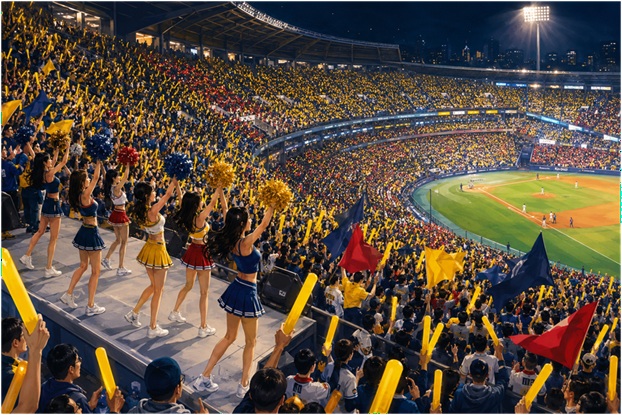
Figure 1. KBO Stadium Cheer Culture — Professional cheerleaders lead tens of thousands of fans in synchronized cheering, waving yellow thunder sticks and pom-poms.
Korean professional baseball has accomplished something no other league in the world has replicated at scale: it transformed passive game-watching into an active, synchronized communal experience. Every KBO player has a dedicated cheer song. Professional cheer leaders stationed in the stands direct crowds of tens of thousands using microphones and amplifiers. Pom-poms wave in unison. The result is an atmosphere that resembles a K-pop concert far more than a conventional sporting event.
This transformation did not happen overnight. Beginning organically in the 1980s and formalizing through the 1990s and 2000s, KBO cheer culture developed into a structured, reproducible system. Teams employ professional cheer squads who rehearse routines, compose new songs for incoming players, and coordinate with the crowd throughout nine innings.
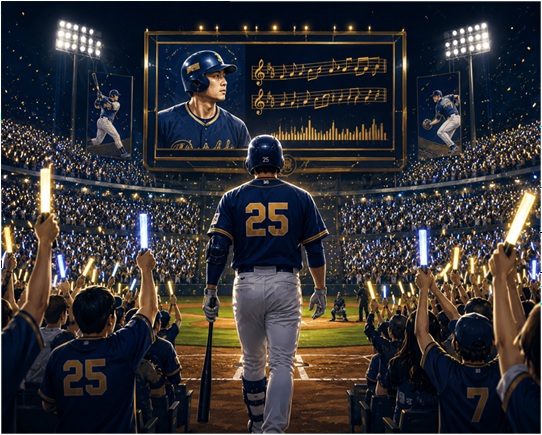
Figure 2. Player-Specific Cheer Songs
Figure 2 depicts a KBO batter walking to the plate as the stadium scoreboard displays his personalized cheer song, while thousands of fans rise in unison, waving glowing light sticks in a synchronized chant.
Why It Is an Innovation
- KBO cheer culture democratized baseball fandom — fans with no knowledge of the sport are drawn to stadiums purely for the participatory atmosphere, dramatically expanding the sport’s audience beyond traditional fans.
- The player-specific cheer song system has been analyzed by MLB executives and international sports marketers as a potential blueprint for revitalizing fan engagement in leagues where attendance has stagnated.
- Cheer culture drove secondary revenue streams: team-branded merchandise, social media virality, and content creation by fans turned each stadium visit into a marketing event.
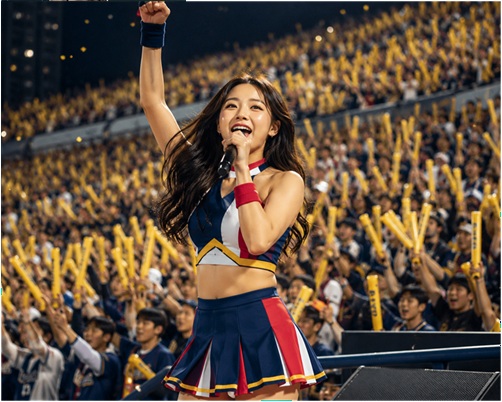
Figure 3. KBO Cheer Squad Leader
Figure 3 features a professional cheerleader commanding the cheer platform, microphone in hand, driving a packed stadium into a frenzy as thousands of fans wave bright yellow thunder sticks in rhythmic unison.
Global Impact
In recent years, journalists from ESPN, The Athletic, and the New York Times have traveled to Korea specifically to report on KBO cheer culture. MLB team executives have made similar trips, exploring whether elements of the KBO model can be adapted for North American audiences. During the 2020 COVID-19 pandemic, when KBO became the first major league to resume play and was broadcast to US audiences via ESPN, millions of American viewers encountered KBO’s cheer culture for the first time — generating widespread fascination and international media coverage.
References
Choi, S., & Kim, J. (2023). Fan participation behavior in Korean professional baseball: The role of cheer culture on game attendance. International Journal of Sport Management and Marketing, 23(4), 312–334. https://doi.org/10.1504/IJSMM.2023.000001
ESPN. (2020, May 5). How KBO baseball became America’s pandemic pastime. ESPN Features. https://www.espn.com/mlb/story/_/id/29101025
New York Times. (2024, April 12). In South Korea, baseball is a party. New York Times Sports. https://www.nytimes.com/2024/04/12/sports/baseball/kbo-cheer-culture.html
The Athletic. (2023, September 18). Why MLB executives are flying to South Korea to study fan culture. The Athletic. https://www.theathletic.com/kbo-cheer-culture-mlb