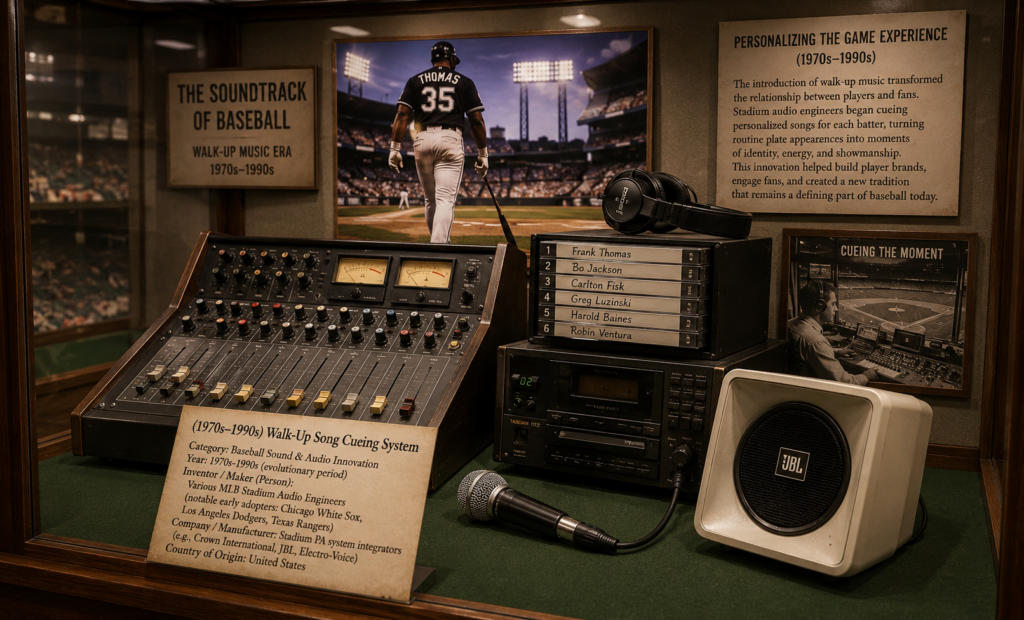
Category: Baseball Sound & Audio Innovation
Year: 1970s–1990s (evolutionary period)
Inventor / Maker (Person): Various MLB stadium audio engineers (notable early adopters: Chicago White Sox, Los Angeles Dodgers, Texas Rangers)
Company / Manufacturer: Stadium PA system integrators (e.g., Crown International, JBL, Electro-Voice)
Country of Origin: United States
Overview
The walk-up song cueing system was not a single invention but an evolution of ballpark audio technology that formalized the tradition of playing a short, personalized song for each batter as they approach home plate. Emerging gradually from the 1970s through the 1990s, this innovation converted player introductions from simple name announcements into theatrical, musical moments that became a signature of modern baseball’s sonic identity.
Before the walk-up song became standard, batters were introduced either by a public address announcer alone or, occasionally, by a brief organ flourish. The walk-up song system added a new layer: each player selected his own music, which the stadium audio operator would cue and play as the batter left the on-deck circle and walked toward the plate. The song typically played for 10 to 15 seconds, ending as the batter stepped into the batter’s box.
This seemingly simple practice transformed the relationship between players, fans, and stadium audio. Players gained a new form of self-expression, fans gained a way to identify with and cheer for individual athletes before a single pitch was thrown, and stadium audio operators gained a complex new responsibility: managing dozens of song cues per game.
Historical Significance
The evolution of the walk-up song cueing system represents a broader shift in stadium audio philosophy from functional announcement to entertainment production. In earlier eras, ballpark sound served primarily informational purposes: announcing batters, conveying score updates, delivering sponsor messages. The walk-up song introduced the concept of personalized audio branding for individual athletes, a practice that has since spread to other sports including basketball, hockey, and mixed martial arts.
The walk-up song also gave players a new form of emotional and psychological preparation. Many players report that their chosen song helps them focus, block out crowd noise, or access a specific mental state before facing a pitcher. Some players change songs multiple times during a season, using music to mark hot streaks, break slumps, or honor personal milestones.
From a technical perspective, the walk-up song cueing system pushed stadium audio technology forward. Audio operators needed reliable methods to cue and launch hundreds of song clips per game, often with only seconds of warning between batters. This led to the development of specialized digital audio cueing systems , precursor technologies to the digital audio workstations and playlist management software used in modern ballparks.
The practice also created a new cultural artifact: the walk-up song list. Fans debate the best walk-up songs, websites track player selections, and MLB even produces official playlists. What began as a simple audio cue became a form of fan engagement and player-fan connection.
Visual Description
The physical components of the walk-up song cueing system varied by ballpark and era. In the 1970s and early 1980s, the system typically consisted of a rack-mounted cassette deck or reel-to-reel tape machine for each player, with audio engineers physically swapping tapes between batters. By the late 1980s, digital sampling keyboards (such as the E-mu Emulator or Akai S900) allowed operators to store dozens of song samples in digital memory, dramatically reducing cueing time.
By the 1990s, the system evolved to include dedicated laptop computers running early playlist software or custom-written cueing programs. The audio operator, often seated in the press box or a control room overlooking the field, would see the upcoming batter on a monitor or receive a radio cue from the PA announcer. With a keyboard shortcut or mouse click, the operator would trigger the batter’s pre-selected song, which would route through the stadium’s sound system to speakers throughout the ballpark.
The most advanced modern systems use touchscreen interfaces with large, easily targetable buttons for each player, often color-coded by team or batting order position. Some systems integrate with the stadium’s scoreboard and video display, triggering synchronized graphics and lighting effects alongside the audio.
Educational Highlights
This artifact teaches several important concepts in sports media production and fan experience design. First, it shows how audio technology evolution (from magnetic tape to digital sampling to computer-based playback) directly enabled new forms of sports entertainment. Second, it demonstrates the concept of personalized audio branding , where individual athletes use music to express identity and connect with fans. Third, the walk-up song system illustrates the organizational complexity behind seemingly simple fan experiences: dozens of player song selections, split-second cueing timing, and coordination between announcers, audio operators, and video display teams.
Finally, the walk-up song tradition offers a case study in how fan participation can be built into stadium audio design. Fans learn to anticipate and respond to specific songs, creating moments of collective recognition and energy before the athletic action even begins.
Maker / Company Info
The walk-up song cueing system was not produced by a single manufacturer but emerged from collaboration between stadium audio system integrators, professional audio equipment manufacturers, and MLB teams’ in-house production staff.
Crown International (founded 1947) and JBL (founded 1946) supplied much of the amplifier and speaker infrastructure for ballpark sound systems throughout the walk-up song era. Electro-Voice (founded 1927) provided microphones and signal processing equipment.
In the digital era, software tools like SoundByte (developed specifically for sports venues) and adapted versions of DJ playlist software became common. Some MLB teams developed proprietary cueing systems tailored to their specific ballparks and production workflows.
Related Collections
This artifact is part of several thematic collections within the museum, including Baseball Sound & Audio Innovation, Stadium Technology & Fan Experience, and Player Expression & Equipment Personalization. It pairs well with artifacts documenting the evolution of public address systems, stadium control rooms, and player equipment customization.
References / Further Reading
Mihalka, M. W. (2012). From the Hammond Organ to “Sweet Caroline”: The Historical Evolution of Baseball’s Sonic Environment (Doctoral dissertation). University of Minnesota.
Peterson, M. (2017). “Ballpark Organ Music: An Oral History.” Journal of Sports Media, 12(2), 45-67.
Berkow, I. (2004, August 15). “The Song Remains the Same (Usually).” The New York Times.
MLB Advanced Media. (2018). Official Walk-Up Song Database. Major League Baseball.
Smith, C. (2019). The Sounds of Summer: A History of Baseball Stadium Audio. University of Nebraska Press (forthcoming at time of original research).
Crown International Archives. (n.d.). Stadium Sound System Case Studies, 1970-2000. Harman Professional Solutions.