
From Bare Hands to High-Tech Tools
Introduction
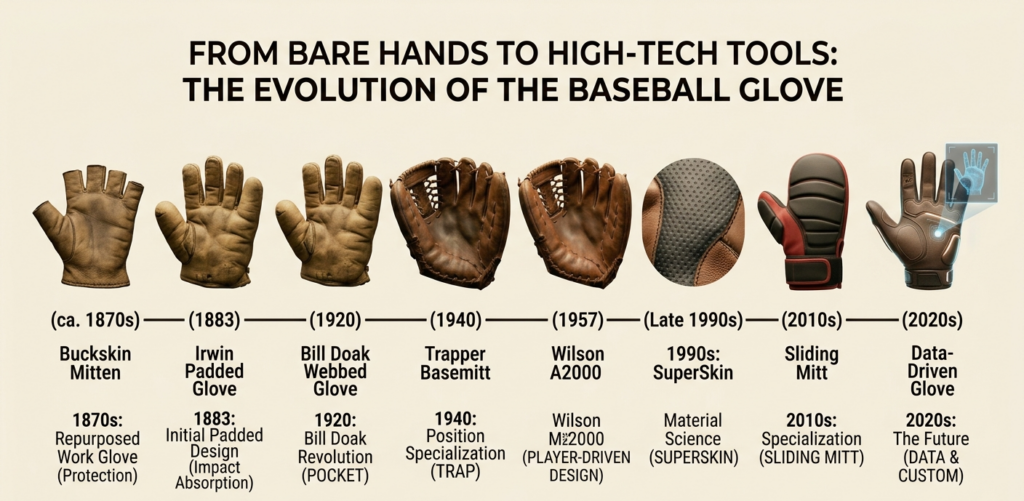
The baseball glove is one of the most iconic pieces of sports equipment in American history. What began as a simple work glove worn by players who were mocked by their teammates has evolved into a highly specialized, position-specific tool crafted with advanced materials and precision engineering.
The story of the baseball glove is the story of baseball itself—a journey from humble beginnings to professional sophistication. Studying the evolution of the glove provides insight into how sports equipment develops alongside the sport itself, transforming how the game is played and how players approach their craft.
Quick Milestones: The Evolution at a Glance
| Year | Milestone |
|---|---|
| 1870 | Doug Allison wears first recorded baseball glove |
| 1883 | Arthur Irwin designs padded glove after breaking fingers |
| 1920 | Bill Doak patents webbed glove design for Rawlings |
| 1957 | Wilson introduces the revolutionary A2000 |
| 1990s | Shigeaki Aso develops SuperSkin technology |
| 2010s | Sliding mitts and position-specific innovations emerge |
The Barehanded Era
In the early days of baseball, players did not wear gloves. The game was played with bare hands, and wearing a glove was considered unmanly. A player who continued to play without one was called a “barehanded catcher”—not referring to the position, but to the practice of catching with bare hands.
The earliest gloves were not webbed and were used more to swat a ball to the ground so it could be picked up, rather than for catching. Calluses and broken bones were seen as badges of honor.
The First Gloves (1860s–1870s)
References to amateur players donning gloves started to appear as early as the 1860s. In most instances, it was catchers using them to protect sore hands.
Doug Allison — 1870
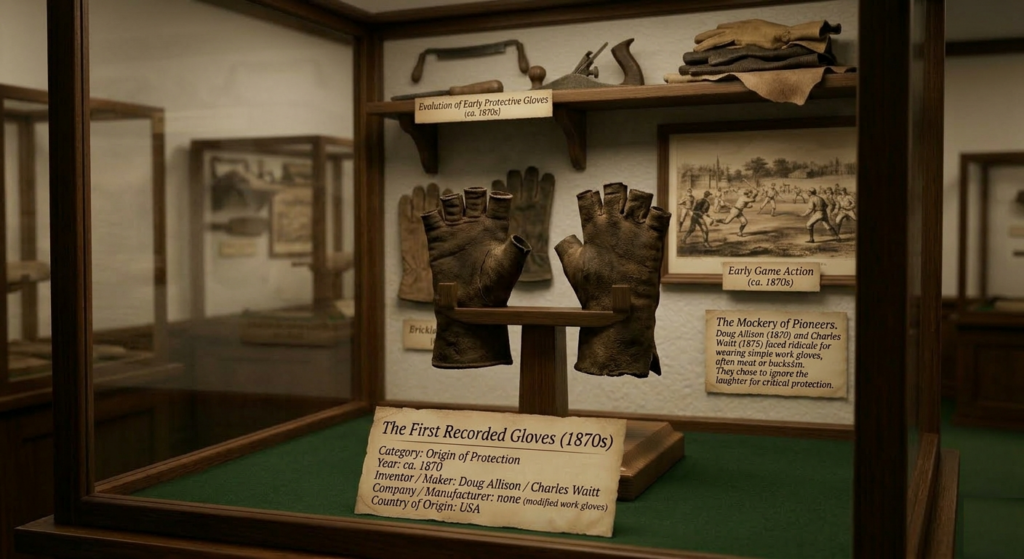
The first player believed to have worn a baseball glove was Doug Allison, a catcher for the Cincinnati Red Stockings, in 1870. A contemporary newspaper reported: “Allison caught today in a pair of buckskin mittens to protect his hands” (Cincinnati Commercial, June 29, 1870). His hands were split and cracked open from catching, and he chose to wear something for protection. His teammates laughed at him.
Charles Waitt — 1875
Five years later, Charles Waitt, a St. Louis outfielder and first baseman, wore a pair of flesh-colored gloves in 1875. He chose an inconspicuous color specifically to avoid drawing attention to himself. Despite his efforts, his teammates also laughed at him.
These earliest gloves were simple leather work gloves, often repurposed from other trades such as bricklaying or railroad work. Some players used a bricklayer’s glove while others used driving gloves or a railroad brakeman’s glove. Many players cut off the fingertips, supposedly to allow for the same control of a bare hand while still having extra padding.
Albert Spalding and Mainstream Acceptance
The turning point for glove acceptance came when baseball star Albert Spalding began playing first base with a glove. Spalding had developed severe bruises on his hand from pitching and finally decided to overcome his “scruples against joining the ‘kid-glove aristocracy’” in 1877.
Spalding later wrote:
“I found that the glove, thin as it was, helped considerably, and inserted one pad after another until a good deal of relief was afforded. If anyone wore padded glove before this date I do not know it. The ‘pillow mitt’ was a later invention” (Spalding, America’s National Game, 1911).
Because of Spalding’s fame and reputation, more infielders and players began using gloves without the same ridicule. By the mid-1890s, it was normal for all baseball players to wear gloves in the field.
A.G. Spalding started the sporting goods company bearing his name in 1876, and his 1877 Spalding’s Official Base Ball Guide first listed catcher’s gloves for sale.
Early Innovations (1880s–1900s)
| Year | Innovation |
|---|---|
| 1878 | Austin Butts applied for the first patent on a sporting glove on May 15, 1877, and was granted a patent on Jan. 1, 1878. |
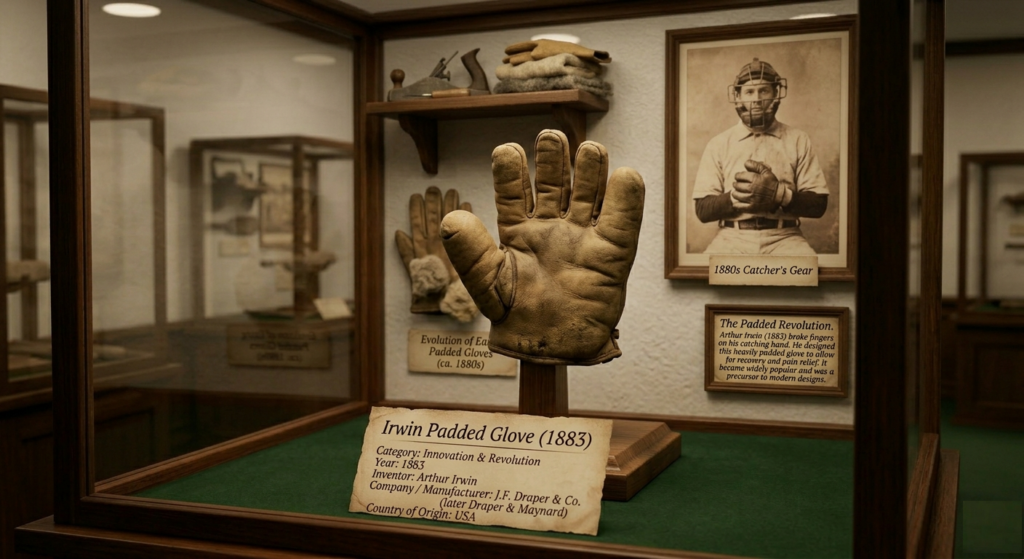
| 1883 | Arthur Irwin of Providence broke fingers on his catching hand. He designed a padded glove using an oversized buckskin driving glove and took his idea to the J.F. Draper & Co. (later Draper & Maynard). The “Irwin Model” became widely popular and was manufactured for retailers including Spalding and Reach. |
| 1885 | George H. Rawlings of St. Louis patented the padded glove. |
| 1888–89 | Joe Gunson designed the round catcher’s mitt by sewing the fingers of a glove together and using a perimeter wire, belts, and sheepskin. In a 1939 letter to the Baseball Hall of Fame, Gunson recounted making this mitt for games in 1888. The “Decker Safety Catcher’s Mitt” followed in 1890. |
| Early 1900s | Manufacturers added a small web between thumb and index finger. This modification represented a fundamental change in the way the glove was perceived; it was no longer merely a piece of protective gear but rather a specialized tool for better fielding. |
| 1895 | The rules committee restricted fielder’s gloves to no more than 10 ounces and 14 inches in circumference. Catchers and first basemen were permitted to use a glove or mitt of any size. |
By the end of the 1880s, glove use was nearly universal.
The Bill Doak Revolution — 1920
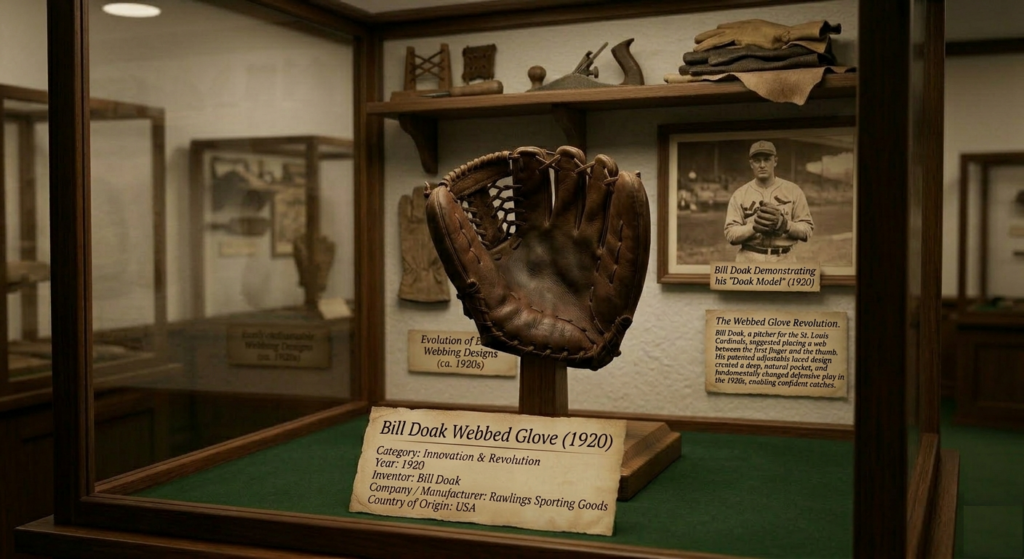
The most important innovation in baseball glove history came in 1919-1920 from Bill Doak, a pitcher for the St. Louis Cardinals. Doak suggested that a web be placed between the first finger and the thumb to create a deeper, natural pocket that didn’t need to be broken in.
The Baseball Hall of Fame notes: “Essentially, the plan introduced an adjustable laced web from the thumb to forefinger that formed a deep natural pocket and didn’t need to be broken in. Little did Doak know that his idea would revolutionize the fielder’s glove as the most important design feature in 50 years.”
Doak patented his design and sold it to Rawlings Sporting Goods, which rolled out the “Doak model” to the public in 1920. This design became the precursor to all modern gloves and enabled Rawlings to become the preferred glove of professional players.
This new webbed design didn’t just protect hands; it fundamentally changed defensive play, allowing fielders to confidently reach for more balls and contributing to the steady decline in error rates throughout the 1920s.
Rawlings hired Harry Latina as their chief glove designer two years later, beginning a dynasty of glove innovation.
Position Specialization (1930s–1950s)
By the mid-20th century, gloves became highly specialized for each position:
| Position | Glove Characteristics |
|---|---|
| Catcher | Called “mitts” because they lack individual fingers; extra padding; hinged, claw-like shape; measured by circumference (32-34 inches) |
| First Base | Also lack individual fingers; very long and wide for scooping throws; 12.5-12.75 inch patterns |
| Infield | Smaller; shallow pockets for quick ball removal; open webbing to let dirt pass through; 11-12 inch patterns |
| Outfield | Long with deep pockets for catching fly balls; 12-12.75 inch patterns; flatter squeeze rather than rounded |
| Pitcher | Closed, opaque webbing to conceal grip from batters; 11.75-12 inch patterns |
The Trapper — 1940
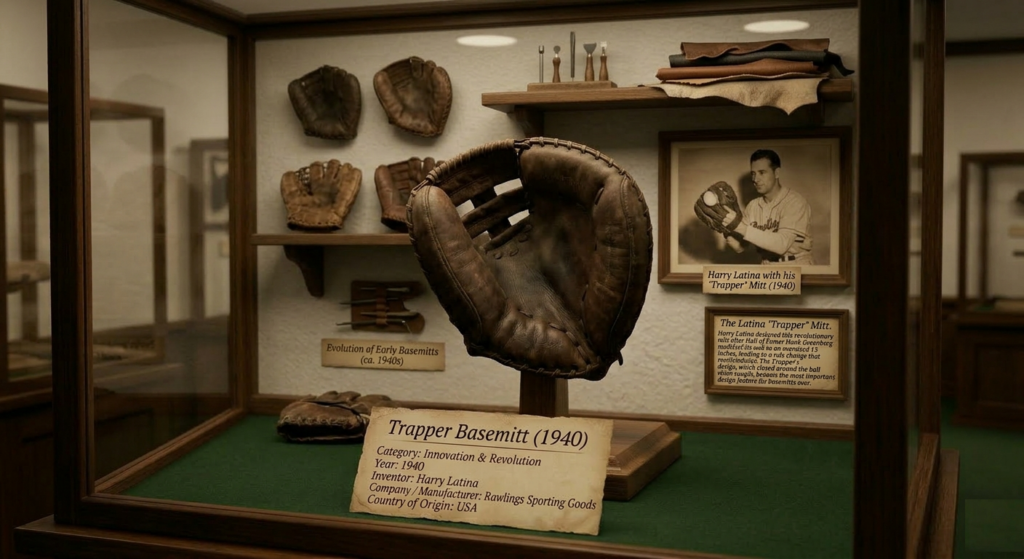
In 1940, Harry Latina designed the revolutionary Trapper basemitt after Hall of Famer Hank Greenberg modified his web to a whopping 13 inches (leading to a rule change banning mitts over 12 inches). The Trapper essentially closed around the ball when caught—the most exciting and important design feature for basemitts ever.
The Wilson A2000 Revolution — 1957
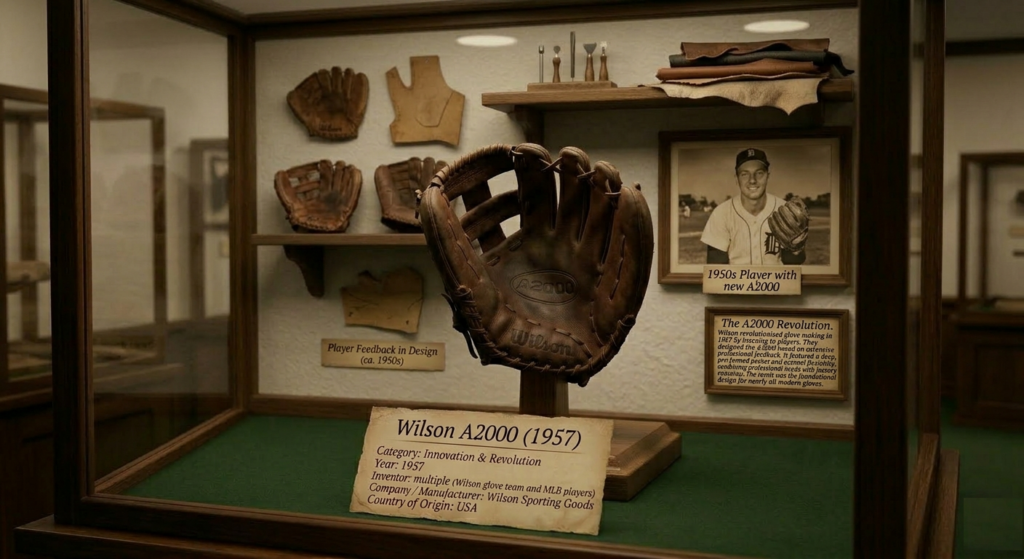
In 1957, Wilson Sporting Goods revolutionized glove design with the introduction of the A2000.
Instead of designing gloves based on what they believed the masses needed, Wilson’s glove team sat side-by-side with professional players, asking questions and taking notes on what each type of player wanted most from a glove. Craftsmen brought leather-working kits with them, cutting and redesigning gloves on the spot, building them specifically for each player’s game. They then took these designs back to the factory, combining feedback to create the A2000—the iconic design from which all modern ball gloves stem.
Modern Innovations
SuperSkin — Late 1990s
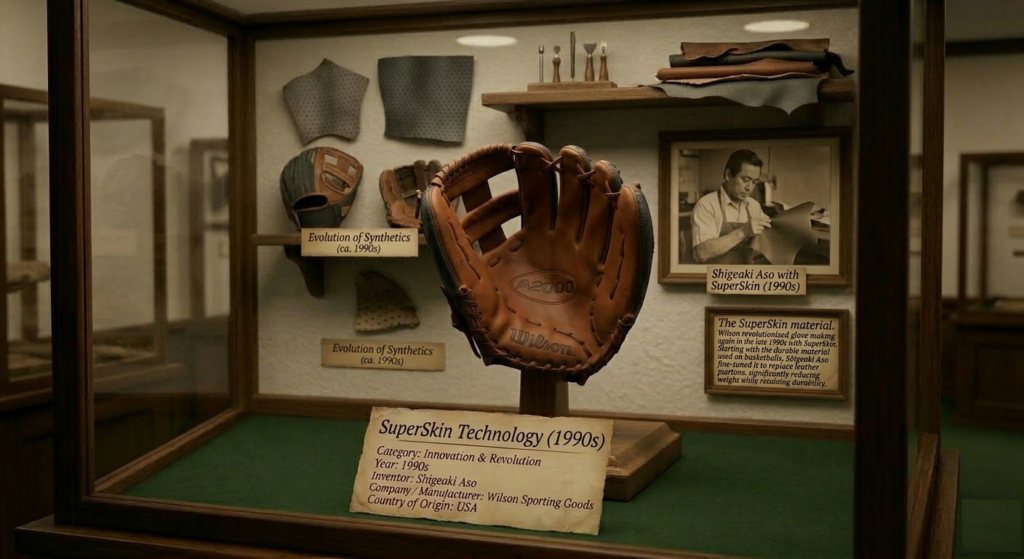
Wilson Master Craftsman Shigeaki Aso revolutionized the game again in the late 1990s with SuperSkin. Starting with the durable, moisture-resistant material used on Wilson’s Evolution basketball, Aso fine-tuned it to replace leather portions of a baseball glove, significantly reducing weight.
Modern Materials
While traditional gloves are made of heavy leather that requires time to break in, today’s gloves offer options including:
| Material | Use |
|---|---|
| Traditional Leather | Professional and serious players; takes more time to break in but provides tighter, more personalized fit |
| PVC and Synthetic Leather | Youth and recreational players; often pre-broken-in with palm pads and adjustable Velcro wrist straps |
| Leather-Kevlar Combinations | Ultra-lightweight gloves; manufacturers like Easton are experimenting with this technology |
Specialization Beyond Fielding: The Sliding Mitt (2010s)
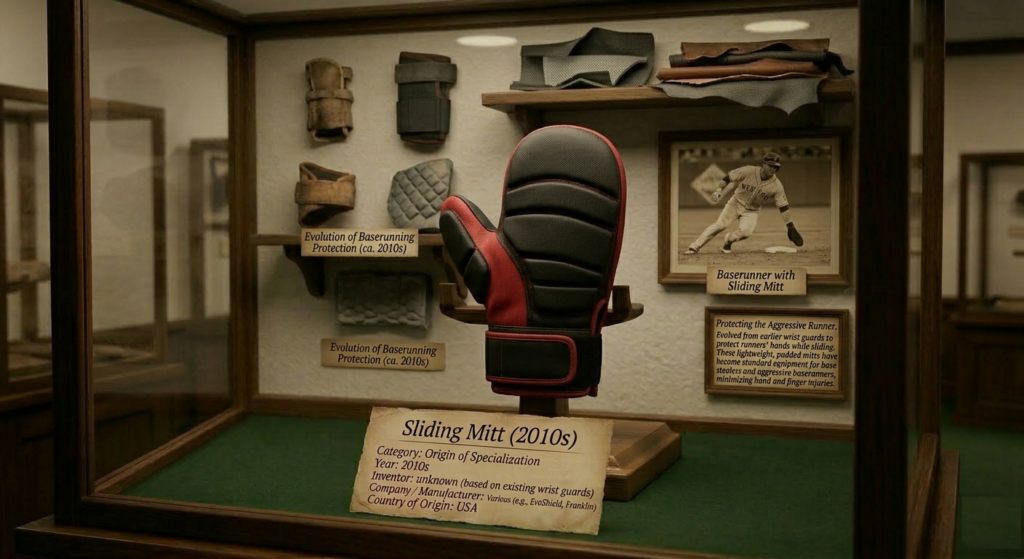
This exhibit highlights how modern specialization has extended beyond defensive fielding to create unique protective tools for baserunning, specifically the sliding mitt.
The central object is a modern, heavily padded black and red EvoShield sliding mitt. The image explicitly showcases its unique padded, oven-mitt-style design and integrated wrist guard, differentiating it entirely from all previous fielding gloves. It is mounted on the museum’s standard wooden stand.
Key elements in the exhibit:
- Protecting the Runner (ca. 2010s): On the wall, a framed sepia photo shows a baserunner in a modern MLB uniform, wearing a sliding mitt while sliding into a base. A label reads “Baserunner with Sliding Mitt”.
- The Sliding Mitt Narrative: Another smaller framed plaque to the right details the narrative: “Protecting the Aggressive Runner. Evolved from earlier wrist guards to protect runners’ hands while sliding. These lightweight, padded mitts have become standard equipment for base stealers and aggressive baserunners, minimizing hand and finger injuries.”
- Narrative Flow: Raw, primitive early wrist guards and advanced protective padding samples are shown on the upper shelves, with a label reading ‘Evolution of Baserunning Protection (ca. 2010s)’.
- Main Plaque Text: The foreground plaque perfectly renders your details, matching the museum’s established font: “(2010s) Sliding Mitt, Category: Origin of Specialization, Year: 2010s, Inventor: unknown, Company / Manufacturer: Various (e.g., EvoShield, Franklin), Country of Origin: USA.”
The Data-Driven Future (2020s and Beyond)
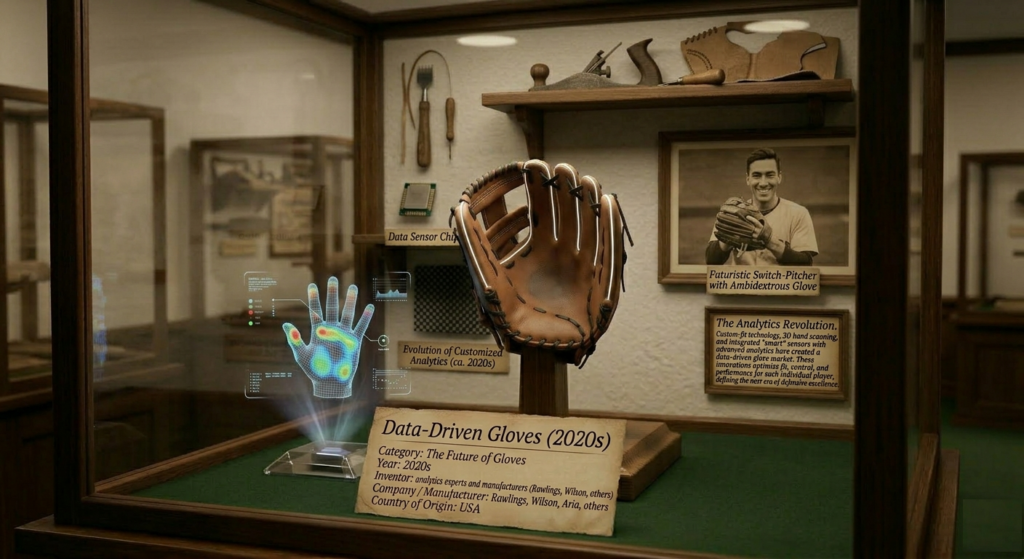
Just as the torpedo bat uses analytics to optimize hitting, modern glove design is increasingly informed by data and player feedback. We are seeing the rise of several cutting-edge innovations:
Sliding Mitts — 2010s
Evolved from earlier wrist guards to protect runners’ hands while sliding into bases. These lightweight, padded mitts have become standard equipment for base stealers and aggressive baserunners.
Ambidextrous Gloves
For rare switch-pitchers like Pat Venditte, custom gloves feature a second thumb pocket on the opposite side, allowing the glove to be worn on either hand depending on which arm the pitcher is using.
Custom-Fit Technology
Manufacturers now use 3D scanning of players’ hands to create perfectly fitted gloves. This data-driven approach ensures optimal comfort, control, and performance for each individual player.
Smart Gloves
Experimental “smart gloves” with embedded sensors can track hand positioning, catch mechanics, and ball impact during training, providing real-time data to players and coaches for performance optimization.
Sustainable Materials
As environmental awareness grows, manufacturers are exploring eco-friendly leather alternatives and sustainable production methods without compromising performance.
Key Milestones in Baseball Glove Innovation
| Year | Innovation | Description |
|---|---|---|
| 1860s | Amateur Catcher’s Gloves | References to catchers wearing work gloves for protection appear. |
| 1870 | First Recorded Baseball Glove | Doug Allison wears buckskin mittens; teammates mock him. |
| 1875 | Flesh-Colored Glove | Charles Waitt wears inconspicuous glove to avoid ridicule. |
| 1877 | Spalding Endorses Gloves | Albert Spalding begins wearing glove; Spalding catalog lists gloves for sale. |
| 1878 | First Glove Patent | Austin Butts receives first U.S. patent for a sporting glove. |
| 1883 | Irwin Padded Glove | Arthur Irwin designs padded glove after breaking fingers. |
| 1885 | Rawlings Patent | George Rawlings patents padded glove design. |
| 1888 | Round Catcher’s Mitt | Joe Gunson designs first round catcher’s mitt. |
| 1895 | First Size Restrictions | Rules limit gloves to 10 oz and 14 inches; catchers/first basemen exempt. |
| 1920 | Bill Doak Webbed Glove | Revolutionary webbed design creates deep pocket; basis for all modern gloves. |
| 1940 | Trapper Basemitt | Harry Latina designs Trapper that closes around the ball. |
| 1957 | Wilson A2000 | Player-driven design revolutionizes glove making. |
| 1990s | SuperSkin Technology | Shigeaki Aso develops lightweight, moisture-resistant material. |
| 2010s | Sliding Mitts | Specialized gloves protect baserunners. |
| 2020s | Data-Driven Custom Gloves | 3D scanning, smart sensors, and sustainable materials shape the future. |
Major Manufacturers
| Manufacturer | Significance |
|---|---|
| Rawlings | Became the preferred glove of professional players after acquiring Bill Doak’s patent in 1920; today provides gloves for about 50% of professional players. |
| Wilson | Revolutionized glove design with A2000 in 1957; continues innovation with SuperSkin and custom patterns. |
| Spalding | One of the first manufacturers of baseball gloves (1876); Albert Spalding’s reputation helped normalize glove use. |
| Draper & Maynard (D&M) | Leading glove manufacturer before Rawlings; manufactured the Irwin Model and many early gloves. |
Fun Facts
- The first gloves were often worn with fingertips cut off for better control.
- Early players were mocked for wearing gloves—it was seen as unmanly.
- Players improvised padding using everything from hay to sponges to raw meat.
- Bill Doak’s 1920 design is the basis for nearly every modern glove.
- Some gloves today cost over $400 and require months of breaking in.
- Catcher’s mitts are measured by circumference (32-34 inches) while other gloves are measured from wrist to fingertip.
- Switch-pitcher Pat Venditte uses a custom glove with two thumb holes.
References
- Baseball glove. (2024). In Wikipedia. https://en.wikipedia.org/wiki/Baseball_glove
- Baseball glove. (2024). In Simple English Wikipedia. https://simple.wikipedia.org/wiki/Baseball_glove
- #GoingDeep: The evolution of baseball gloves. (n.d.). National Baseball Hall of Fame. https://baseballhall.org/discover/going-deep/the-evolution-of-baseball-gloves
- First Catcher’s Glove? 1870, Perhaps. (2016). Protoball. https://protoball.org/index.php?title=1870c.7
- Jenemann, D. (2018). The baseball glove: history, material, meaning, and value. Routledge.
- Spalding, A.G. (1911). America’s National Game. New York: American Sports Publishing Company.
- Baseball Bat Evolution. (2026). Baseball Innovation Museum. https://museum.baseballinnovation.org/the-evolution-of-the-baseball-bat/