
Category: Batting & Hitting
Year: 1974
Inventor / Maker (Person): Various designers (early adopters in collegiate baseball)
Company / Manufacturer: Louisville Slugger / Other early manufacturers
Country of Origin: USA
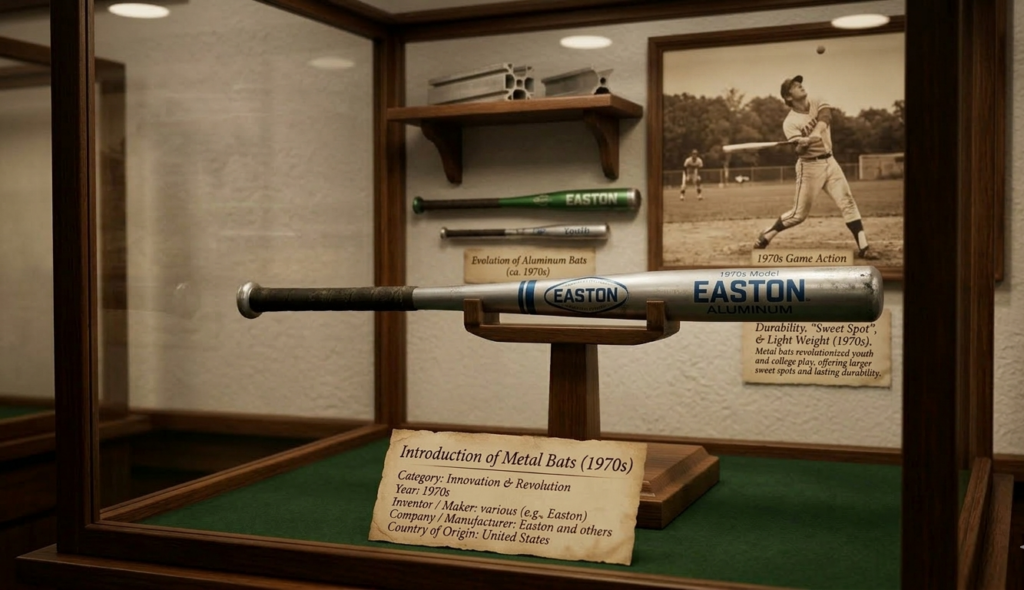
Overview:
The aluminum bat, first widely introduced in 1974, revolutionized amateur and collegiate baseball. Lightweight and durable, aluminum bats allowed players to swing faster and hit balls farther than with traditional wooden bats. Louisville Slugger and other manufacturers quickly popularized aluminum models, making them standard in high school and college leagues.
Historical Significance:
- First widely adopted metal bat in baseball, marking a shift from wood to lightweight alloys.
- Increased swing speed and hitting distance, improving overall offensive performance in amateur leagues.
- Laid the foundation for later composite bats like the Easton Mako, influencing modern bat technology.
Visual Description:
Display of a classic aluminum bat, highlighting its hollow, tubular body, lightweight construction, and smooth metallic finish. Early designs often featured minimal branding and simple barrel shapes optimized for durability and swing speed.
Educational Highlights:
- Learn how aluminum material changes weight distribution and swing mechanics.
- Understand the impact of lightweight, hollow bats on batting performance.
- Explore the evolution from wood → aluminum → composite → modern torpedo bats in baseball history.
Maker / Company Info:
Louisville Slugger – Founded in 1884 in Louisville, Kentucky, USA, Louisville Slugger became a leading bat manufacturer and was among the first to produce aluminum bats for amateur leagues. The company helped establish performance and safety standards that guided the evolution of metal and composite bats.
Reference / Sources:
- Louisville Slugger – Historical Product Catalogs and Bat Specifications
- Thorn, J., & Palmer, P. (1998). The Hidden Game of Baseball – discussion on metal bat introduction
- NCAA Equipment Archives – Aluminum Bat Technology and Adoption in Collegiate Baseball