
Category: Baseball Sound & Audio Innovation
Year: 2022 (introduced MLB Opening Day 2022)
Inventor / Maker (Person): John Hankins, Craig Filicetti
Company / Manufacturer: PitchCom (privately held)
Country of Origin: United States
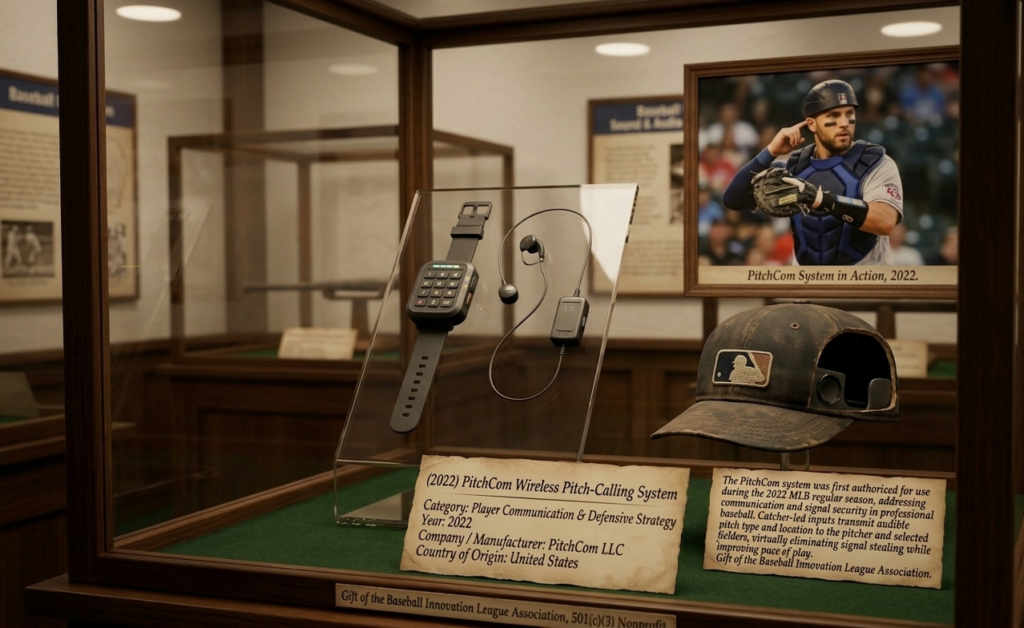
Overview
The PitchCom wireless pitch-calling system is a wearable audio device that allows catchers to transmit pitch calls directly to pitchers (and up to four other fielders) through a small speaker hidden inside the pitcher’s hat. Instead of using traditional finger signs, the catcher presses buttons on a wrist-worn keypad, selecting pitch type and location. The pitcher hears a pre-recorded voice—in English or Spanish—announcing the call, such as “fastball high” or “curveball away.”
Introduced at the start of the 2022 MLB season, PitchCom was initially met with skepticism from traditionalists. By mid-season, over half the league’s teams had adopted the technology. Within two years, it became standard equipment throughout Major League Baseball.
Historical Significance
PitchCom solved two problems that had frustrated baseball for over a century. The first was sign stealing. Traditional finger signs could be observed by base runners or coaches and relayed to batters using whistles, hand gestures, or body movements. Electronic sign stealing scandals, most notably the Houston Astros’ 2017-2018 violations, had damaged the sport’s integrity and intensified pressure for a technological solution.
The second problem was the pitch clock. When MLB introduced a pitch timer in 2023, catchers could no longer waste time cycling through multiple signs. PitchCom delivered the call instantly, allowing pitchers to receive the signal while still focused on the batter.
The system also reduced the physical and mental burden on catchers. They no longer had to remember complex sign sequences for every batter-pitcher matchup, nor did they need to flash signs through their legs, which required awkward crouching and exposed their fingers to opposing base runners.
Perhaps most significantly, PitchCom changed what baseball sounded like. For the first time in 150 years, fans could not hear catchers giving signs—because there were no verbal or audible signs to hear. The communication happened silently, electronically, inside the pitcher’s ear. This quiet revolution eliminated the traditional “chirping” and hand signals that had long been part of the game’s acoustic texture.
Visual and Audio Description
The PitchCom system consists of four physical components. The catcher’s keypad is a wrist-worn device with nine programmable buttons, each labeled with a pitch type or location. The pitcher’s receiver is a small speaker that fits inside the hat’s earflap, weighing approximately one ounce. Receiver units for fielders can be attached to the inside of caps for other players who need to know the upcoming pitch, such as outfielders adjusting their positioning. The charging case simultaneously powers all components between games.
The sound of PitchCom has become an unexpected object of curiosity. The default English voice has been described as “generic, almost Siri-like.” Teams can customize the recordings, and some have experimented with humorous alternatives, including the catchers themselves recording their own voices.
Educational Highlights
This artifact teaches principles of sports technology adoption, audio interface design, and regulatory adaptation. First, it demonstrates how a single technological innovation can address multiple problems simultaneously—sign stealing, pace of play, and cognitive load.
Second, it illustrates the challenge of user interface design for high-stress environments. The catcher must locate and press the correct button without looking at the keypad, while wearing a helmet and mask, in less than 15 seconds between pitches.
Finally, PitchCom represents a rare instance where technology fundamentally changed who speaks during a baseball game. The catcher’s voice—previously used to call pitches verbally in some situations—was replaced by a machine. The traditional sound of the catcher’s finger clicks and verbal calls disappeared from the ballpark.
Maker / Company Info
PitchCom was founded by John Hankins and Craig Filicetti, two entrepreneurs with backgrounds in audio technology and sports equipment. The company operates privately and does not disclose financial information. After successful adoption in MLB, PitchCom expanded into college baseball, minor league baseball, and other sports including football and softball.
References / Further Reading
Silverman, B. (2025, June 26). “Mets Broadcast Showcases What PitchCom Transmitters Sound Like in MLB Player’s Ears.” KTLA.
Passan, J. (2022, April 7). “How PitchCom became baseball’s newest — and loudest — innovation.” ESPN.