Category: Baseball Sound & Audio Innovation
Year: 2011
Inventor / Maker (Person): DTS Engineering Team (Jon Kirchner, CEO)
Company / Manufacturer: DTS, Inc. (now part of Xperi Corporation)
Country of Origin: United States
Overview
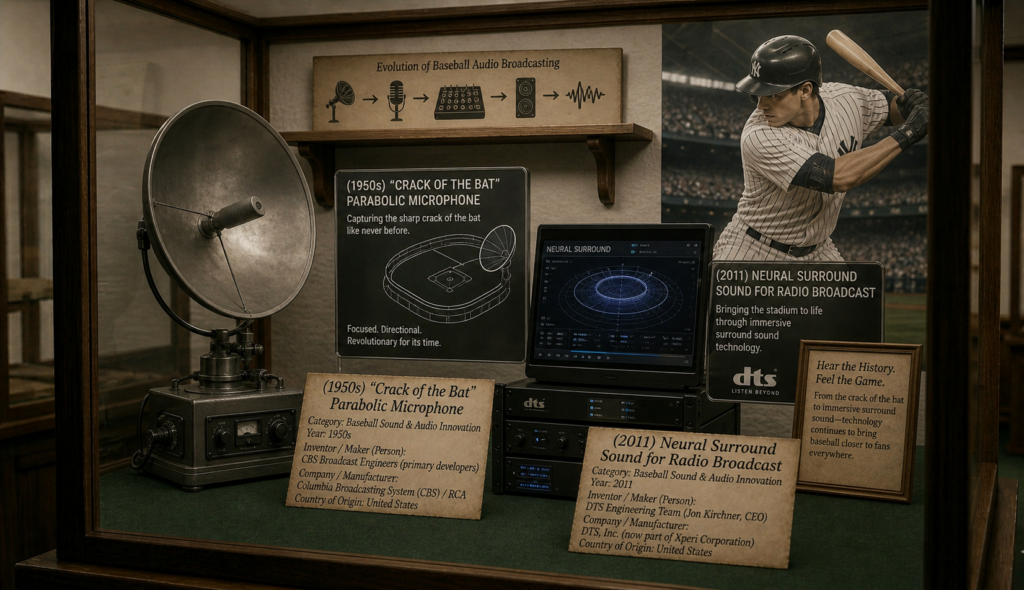
The Neural Surround Sound system for radio broadcast , implemented by the Atlanta Braves Radio Network in 2011, represented a fundamental breakthrough in how baseball sounded on the radio. For the first time, listeners could experience baseball games in 5.1 channel surround sound over standard stereo FM radio signals . This innovation addressed a limitation of radio that had existed since the medium’s earliest days: the flat, two-dimensional audio that placed all sounds—announcer’s voice, crowd roar, crack of the bat—in the same sonic space.
The technology used a coding system that encoded surround sound information within a standard two-channel stereo signal . Any FM radio could decode the enhanced stereo signal, but radios equipped with surround sound decoders could reproduce the full 5.1 channel experience, placing the listener “in the grandstands” with the crowd around them and the action on the field before them .
Historical Significance
The Braves Radio Network was the largest in baseball, with 150 affiliates across the southeastern United States . When it adopted Neural Surround Sound in 2011, it became the first major sports network to deliver surround sound baseball broadcasts over terrestrial radio. This was not a niche technology experiment; it was a mainstream deployment reaching millions of listeners.
The system worked by preserving the integrity of the surround mix through the broadcast chain. The Braves’ production team placed microphones strategically around Turner Field to capture ambient crowd sound, on-field action, and the public address system on separate channels , then encoded these channels into a stereo-compatible signal . The result was described as giving listeners the sense that “they’re sitting in the grandstands” .
Gary Kline, Vice President of Engineering for Cumulus Media (which operated the Braves Radio Network), noted that the surround sound was particularly effective in digital HD Radio , where “the sound is amazing. Especially when the popcorn guy is in the stands” . By 2011, DTS reported that approximately 900 radio stations in the United States were using their Neural Surround Sound technology in some form .
Visual Description
Unlike physical artifacts such as a microphone or organ, this innovation is primarily a software and encoding technology . The visual elements of the system included the audio production console at Turner Field , where broadcast engineers monitored multiple audio channels, and the encoding hardware manufactured by DaySequerra (which licensed the DTS technology) that performed the surround encoding . For listeners, the only visible evidence was a small indicator light on their HD Radio or home theater receiver displaying “DTS Neural” or “Surround.”
Educational Highlights
This artifact teaches important concepts in broadcast engineering and media technology adoption. First, it demonstrates how perceptual audio coding (the same principles used in MP3 and AAC) can be applied to create immersive experiences within the constraints of legacy broadcast systems. Second, it shows the coordination required for technological adoption: broadcasters must install encoding equipment, radio stations must have decoding capability or at least stereo compatibility, and listeners need appropriate playback systems to experience the full effect. Third, the Braves Radio Network deployment illustrates how regional sports networks often serve as early adopters of broadcast technology innovations.
Maker / Company Info
DTS, Inc. (Digital Theater Systems) was founded in 1993 as a competitor to Dolby Laboratories in cinema surround sound. The company’s Neural Surround technology was originally developed for电影的 surround sound and later adapted for broadcast radio. In 2016, DTS was acquired by Tessera Holding Corporation, which later became Xperi Corporation. The Neural Surround technology continues to be used in various broadcast applications.
Related Collections
This artifact is part of several thematic collections within the museum, including Baseball Sound & Audio Innovation, Broadcast Technology History, and Radio Sports Production. It pairs well with artifacts documenting the “Crack of the Bat” microphone and the microphone-equipped base, representing the evolution of broadcast audio from mono to surround.
References / Further Reading
Radio World Staff. (2011, September 6). “Braves Radio Network Implements Surround Sound.” Radio World.
DTS, Inc. (2011). Neural Surround Sound White Paper. DTS Corporate Archives.
Kline, G. (2011). Interview on Neural Surround implementation at Turner Field. Radio World.