
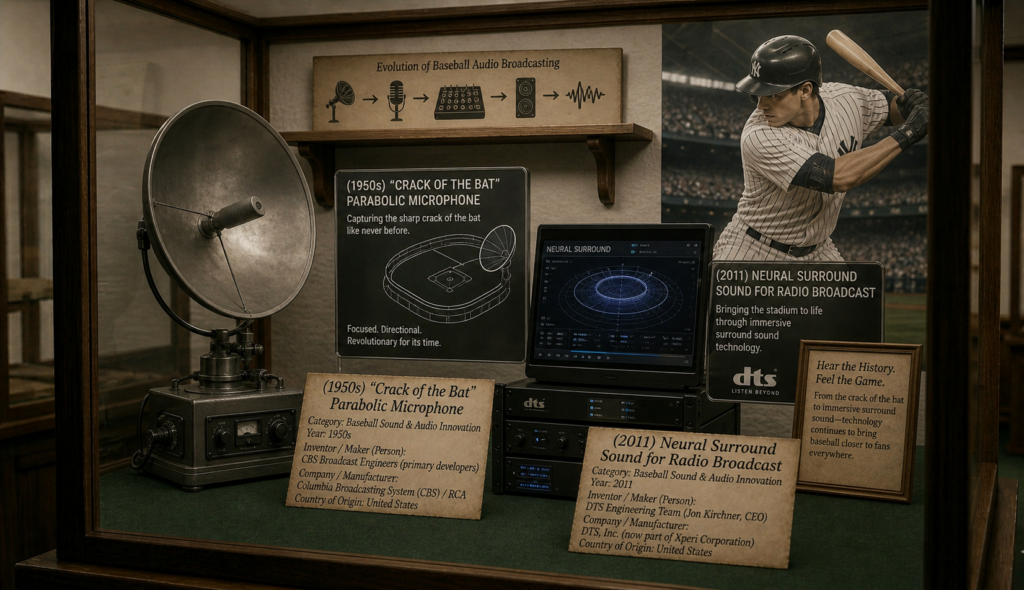
Category: Baseball Sound & Audio Innovation
Year: 1950s
Inventor / Maker (Person): CBS Broadcast Engineers (primary developers)
Company / Manufacturer: Columbia Broadcasting System (CBS) / RCA
Country of Origin: United States
Overview
The “Crack of the Bat” parabolic microphone system was a specialized directional audio device developed by broadcast engineers in the 1950s. Its purpose was singular and revolutionary: to isolate and amplify the distinct sound of a baseball bat striking a ball , making television and radio audiences feel as if they were standing inside the stadium. Before this innovation, broadcast audio was largely ambient—a wash of crowd noise with distant, muffled on-field sounds. The parabolic microphone changed this by capturing specific, dramatic sounds with unprecedented clarity.
The nickname “Crack of the Bat” became shorthand for the immersive audio experience this technology enabled. For the first time, a fan sitting in a living room could hear the sharp, explosive impact of bat meeting ball—the same sound that gave baseball one of its most iconic sensory signatures.
Historical Significance
The parabolic microphone represented a fundamental shift in broadcast audio philosophy. Prior to its introduction, sports broadcasts prioritized speech (announcers describing the action) over ambient or event-specific sounds. The “Crack of the Bat” system demonstrated that capturing the visceral sounds of the game itself could enhance the viewing experience, making audiences feel more connected to the action on the field.
This innovation also marked an early application of audio forensics to sports broadcasting. Broadcast engineers discovered that by isolating the bat-ball impact frequency and filtering out crowd noise, they could detect subtle differences in hit quality—a sharp crack suggested a well-struck line drive, while a dull thud indicated a mis-hit or foul ball. These acoustic cues became valuable information for both casual viewers and serious fans, adding a layer of analytical depth to the broadcast.
Furthermore, the “Crack of the Bat” microphone helped establish the role of sound design in live sports production. The dramatic, amplified sound of a home run became a signature moment in baseball broadcasts, one that producers would replay and emphasize. This tradition continues today, with modern broadcasters using multiple isolated audio feeds to capture the nuances of every swing.
Visual Description
The original “Crack of the Bat” system consisted of a large parabolic reflector dish , typically measuring 18 to 24 inches in diameter, with a small condenser microphone positioned at its focal point. The dish was mounted on a tripod stand and placed near the backstop or along the foul lines, close enough to capture on-field sounds but far enough to avoid interfering with play. The entire assembly was often painted matte black or dark gray to reduce visual distraction for players and spectators.
The parabolic shape functioned as an acoustic lens, collecting sound waves from the direction the dish was aimed and focusing them onto the microphone. This allowed engineers to “zoom in” on specific sounds—the crack of the bat, the pop of the catcher’s mitt, the umpire’s call—while rejecting ambient noise from other directions.
By the late 1950s, these parabolic microphones became standard equipment at professional baseball broadcasts, positioned strategically around the field to capture different perspectives of the action.
Educational Highlights
This artifact teaches several important principles of audio engineering and sports media production. First, it demonstrates how directional microphone technology allows sound engineers to selectively capture specific audio sources in noisy environments—a concept now central to film, television, and live event production. Second, it shows how broadcast innovation often arises from solving practical problems, such as the challenge of making a living room feel like a ballpark. Third, the “Crack of the Bat” system illustrates how sound shapes emotional response in sports viewing; the amplified crack of a home run bat creates a moment of drama and satisfaction that visuals alone cannot achieve.
Maker / Company Info
The Columbia Broadcasting System (CBS) developed the parabolic microphone system in collaboration with RCA (Radio Corporation of America), which manufactured the condenser microphone elements used in the system. CBS, under the leadership of broadcast engineering pioneer Peter C. Goldmark , had a reputation for investing heavily in audio and video innovation. Goldmark’s team had previously developed the first commercial long-playing (LP) record and would later contribute to color television technology.
RCA, founded in 1919, was the dominant force in American radio and television technology for much of the 20th century. Its microphone and sound recording equipment were industry standards in both broadcast and recording studios.
Related Collections
This artifact is part of several thematic collections within the museum, including Baseball Sound & Audio Innovation, Broadcast Technology History, and Sports Media Production. It pairs well with artifacts documenting the evolution of broadcast microphones, stadium public address systems, and modern audio processing technologies used in MLB broadcasts today.
References / Further Reading
Mihalka, M. W. (2012). From the Hammond Organ to “Sweet Caroline”: The Historical Evolution of Baseball’s Sonic Environment (Doctoral dissertation). University of Minnesota.
Walker, J. R. (2015). Crack of the Bat: A History of Baseball on the Radio. University of Nebraska Press.
CBS Engineering Archives. (n.d.). Parabolic Microphone Development Records. Columbia Broadcasting System.
RCA Historical Collection. (n.d.). Studio and Field Microphone Specifications, 1940-1960. David Sarnoff Library.
Goldmark, P. C. (1973). Maverick Inventor: My Turbulent Years at CBS. Saturday Review Press.
Bryant, J., & Raney, A. A. (2000). “Sports on the Screen.” In Handbook of Sports and Media. Lawrence Erlbaum Associates.