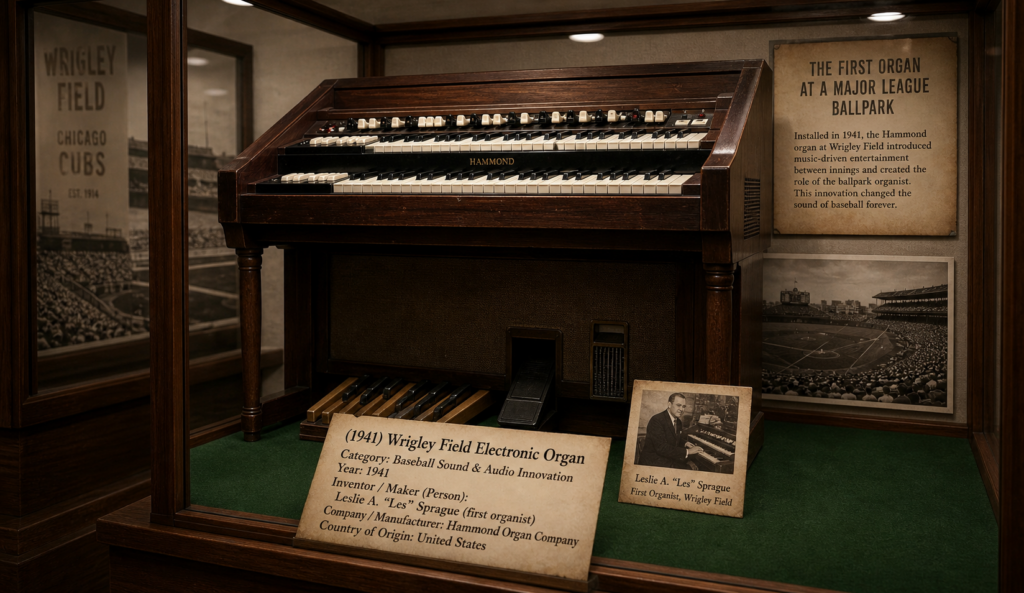
Category: Baseball Sound & Audio Innovation
Year: 1941
Inventor / Maker (Person): Leslie A. “Les” Sprague (first organist)
Company / Manufacturer: Hammond Organ Company
Country of Origin: United States
Overview
The Wrigley Field electronic organ was the first electronic organ installed at a Major League Baseball ballpark. Installed in 1941, it transformed the live fan experience by introducing organized, music-driven entertainment between innings, creating the role of the “ballpark organist” as a permanent fixture of baseball culture. Before its installation, ballpark audio consisted almost entirely of natural crowd noise and occasional public address announcements. The Hammond organ changed this, adding a layer of intentional, musical entertainment that could guide crowd emotion and fill the quiet moments between plays.
Historical Significance
The installation of the Hammond organ at Wrigley Field marked a turning point in sports entertainment. For the first time, a ballpark had a dedicated musical instrument operated by a live performer whose sole job was to entertain fans during breaks in the action. This innovation established the tradition of organ-led fan chants, player introduction music, and between-inning entertainment that spread to nearly every MLB ballpark by the 1950s and 1960s.
The organ also demonstrated how audio technology could shape fan engagement and stadium atmosphere. The Hammond organ’s electronic amplification meant its sound could reach every seat in the stadium, creating a unified audio experience for thousands of fans simultaneously. This concept—using amplified music to shape crowd behavior and emotion—became a cornerstone of modern sports presentation.
Visual Description
The Wrigley Field organ was a Hammond Model BC console organ, featuring two manuals (keyboards) , a set of bass pedals played by the organist’s feet, and a dark wooden cabinet typical of early electronic instruments. It was installed in the Cubs’ press box section of the stadium, positioned behind home plate. The organ projected its sound through the stadium’s existing public address system , which had been installed several years earlier, allowing the music to reach all seating areas from the upper deck to the bleachers.
Leslie “Les” Sprague, the first organist hired by the Cubs, sat at this console during home games, improvising between innings, playing along with crowd chants, and providing musical punctuation for key moments like strikeouts and home runs.
Educational Highlights
This artifact teaches several important lessons about technology and sports. First, it shows how audio technology changed live sports entertainment from a purely visual and social experience to one that included intentional, designed soundscapes. Second, it demonstrates how the organist’s role influenced modern stadium music traditions , including the use of walk-up songs and between-inning entertainment. Finally, it illustrates the transition from acoustic crowd energy to amplified soundscapes , a shift that fundamentally altered how fans experience live sporting events.
Maker / Company Info
The Hammond Organ Company , founded by Laurens Hammond in 1928, revolutionized electronic instruments by creating the first commercially successful electronic organ. Unlike pipe organs, which required massive physical pipes and complex mechanical systems, Hammond organs used electrical tonewheels to generate sound, making them portable, affordable, and practical for venues like ballparks, churches, and theaters.
Related Collections
This artifact is part of several thematic collections within the museum, including Baseball Sound & Audio Innovation, Stadium Technology & Fan Experience, and Early Electronic Music in Sports. It pairs well with artifacts documenting the evolution of public address systems, stadium microphones, and later innovations like walk-up song cueing systems.
References / Further Reading
Mihalka, M. W. (2012). From the Hammond Organ to “Sweet Caroline”: The Historical Evolution of Baseball’s Sonic Environment (Doctoral dissertation). University of Minnesota.
Wrigley Field Archives. (n.d.). Audio Technology Collection. Chicago Cubs Historical Records.
Hammond Organ Company Archives. (n.d.). Model BC Console Specifications. Hammond USA.
Thorn, J. (2011). Baseball in the Garden of Eden: The Secret History of the Early Game. Simon & Schuster.
Peterson, M. (2017). “Ballpark Organ Music: An Oral History.” Journal of Sports Media, 12(2), 45-67.
F