
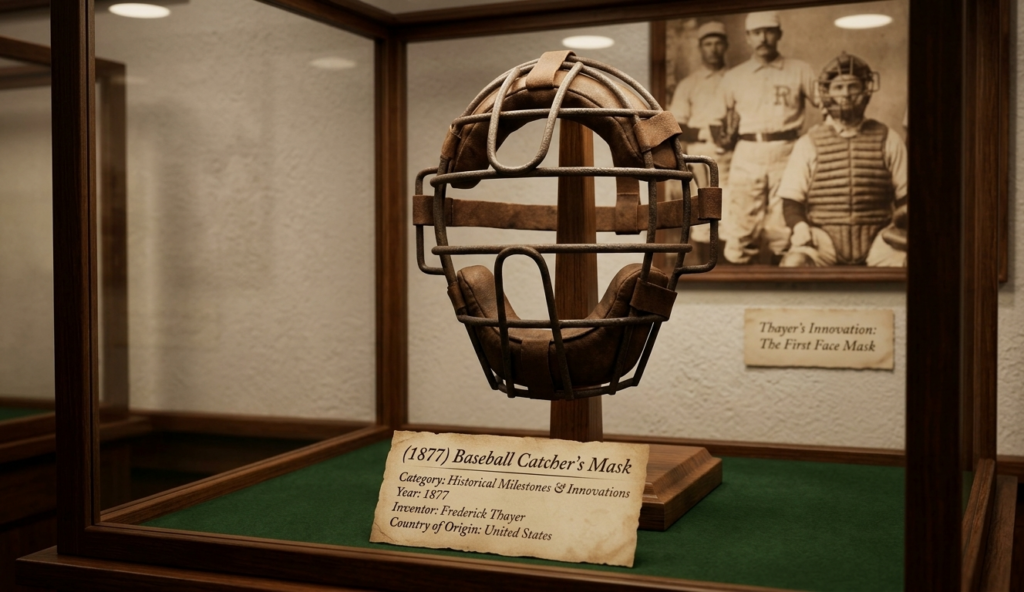
Category: Historical Milestones & Innovations
Year: 1877
Inventor: Frederick Thayer
Country of Origin: United States
Overview
The baseball catcher’s mask was introduced in 1877 by Harvard catcher Frederick Thayer. Before its invention, catchers played without facial protection and were frequently injured by foul tips and fast pitches. The mask used a metal wire frame with padding to shield the face while allowing visibility.
Historical Significance
- One of the first protective devices in baseball.
- Dramatically reduced injuries for catchers.
- Led to the development of modern helmets, chest protectors, and full protective gear.
Visual Description
A wire-frame mask with leather or padded interior lining. Early models were hand-crafted and worn with straps behind the head, allowing catchers to protect their faces while maintaining visibility of the pitcher and batter.
Educational Highlights
- Shows how player safety innovations shaped modern sports equipment.
- Demonstrates the early development of protective gear in baseball.
- Helps visitors understand the evolution from simple protection to modern safety systems.
References
- National Baseball Hall of Fame and Museum – Early Baseball Equipment
- Thorn, J. (2011). Baseball in the Garden of Eden.
- MLB Historical Equipment Archives.